
BLOG POSTS
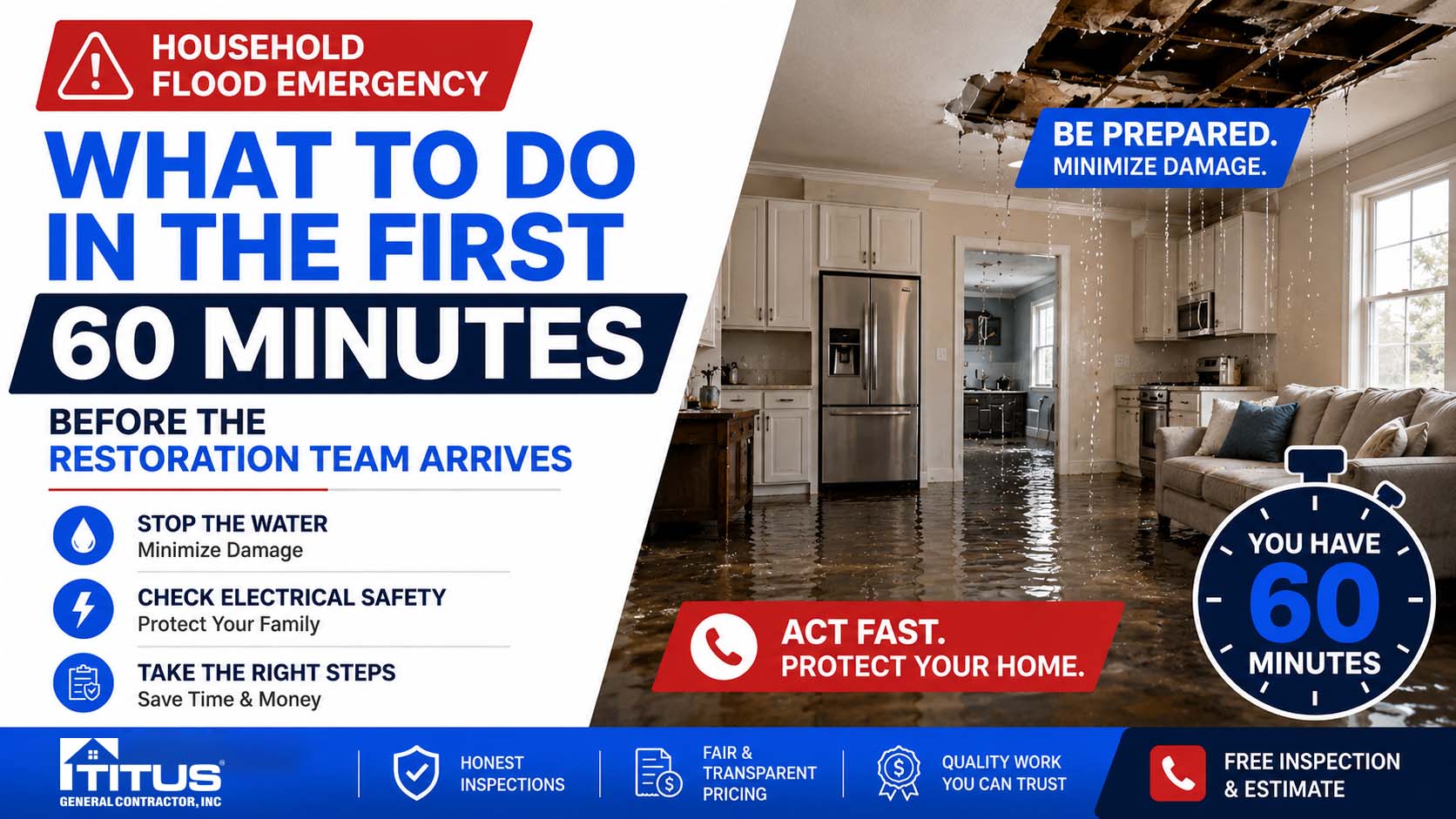
Household Flood Emergency: What to Do in the First 60 Minutes Before the Restoration Team Arrives
If you are in an active flood emergency right now, call Titus GC at 443-551-2181. Scroll to the bottom for the emergency contact section.
Your kitchen ceiling just collapsed with water. Or you walked into the basement and found four inches of standing water. Or you heard a sound behind the wall that you will never forget and now water is running freely down the hallway.
Stop. Breathe. You have exactly 60 minutes to make decisions that determine whether this is a bad day or a catastrophic year.
This guide walks you through every step in that window, in the right order, without panic. The actions you take in the next hour directly affect how much structural damage occurs, how large your insurance claim becomes, and whether mold begins growing inside your walls before the restoration crew arrives.
Save this page. Share it with your family. Read it now so you never have to think during the moment it matters most.
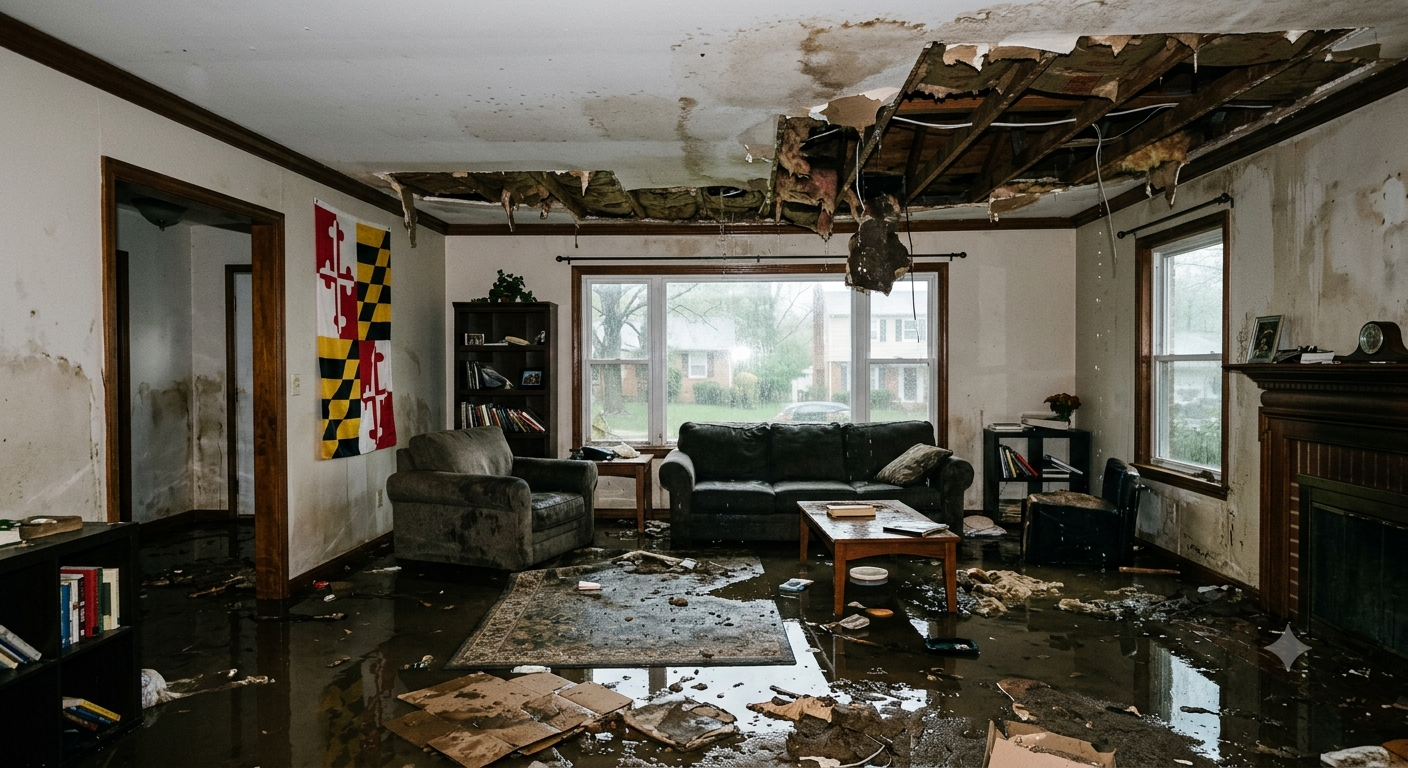
Before Anything Else: The Two Non-Negotiable Safety Checks
Before you touch a single thing, do these two checks. Nothing else matters until these are done.
Check 1: Is anyone in immediate danger? If water is rising rapidly in an enclosed space, get everyone out of that space first. Do not attempt to retrieve belongings. Do not go back for pets if doing so puts you in danger. Evacuate first, act second.
Check 2: Is there any chance of electrical contact with the water? If standing water is present anywhere near an outlet, appliance, or electrical panel, treat every surface as live until the power is confirmed off. Do not step into standing water until the electricity situation is resolved. This is covered in detail in Step 3 below.
Only after confirming physical safety do you move into the 60-minute response sequence.
The 60-Minute Emergency Response Timeline
Minutes 0 to 5: Locate the Source and Confirm the Type of Water
Before you shut anything off, you need 60 seconds of assessment. Identifying the source determines your first action.
Ask yourself three questions:
Where is the water coming from? (A burst pipe inside the wall, an overflowing appliance, a backed-up drain, water coming through the roof or foundation, or a municipal line break)
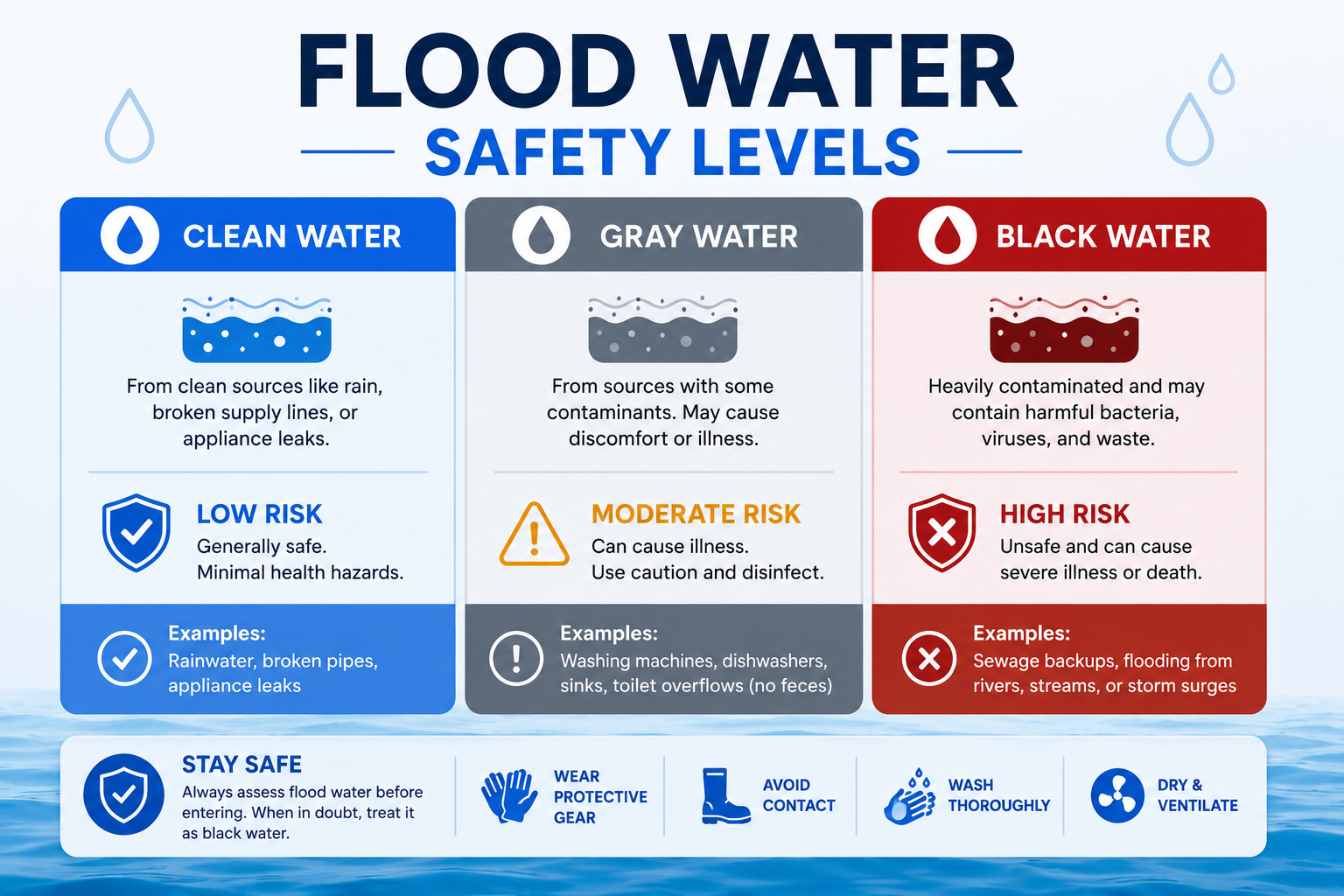
Is it clean water, gray water, or black water?
Is it still actively flowing or has it stopped?
Why water type matters immediately:
Water Category Source Safety Level Handling Clean Water (Category 1) Burst supply pipe, overflowing sink, rain intrusion Relatively safe with normal precautions You can handle initial containment yourself Gray Water (Category 2) Washing machine overflow, dishwasher, toilet overflow (no solids) Mildly contaminated Minimize contact, wear gloves, no cleanup without PPE Black Water (Category 3) Sewage backup, floodwater from outside, standing water over 48 hours Highly contaminated, biohazard Do not touch. Evacuate and call professionals immediately
If the water is black or sewage-contaminated, stop reading this guide and call Titus GC at 443-551-2181 right now. Sewage exposure is a health emergency, not a cleanup task.
Minutes 5 to 10: Shut Off the Main Water Supply
If the source is a burst pipe, failed supply line, or any pressurized interior water source, your single most important action is shutting off the main water supply to the house. Every second the water runs is more damage.
How to Find Your Main Water Shutoff
In Maryland homes, the main shutoff valve is typically located in one of these places:
Inside the basement or utility room: Look along the front wall of the basement, facing the street. The valve is usually near the water meter and will be either a gate valve (round wheel handle) or a ball valve (lever handle)
In a crawl space: Near the main entry point where the service line enters the home
Outside near the foundation: Some homes have the shutoff accessible through a covered box in the ground near the front of the house
At the street meter box: The municipality shutoff at the street requires a special tool (meter key), but your plumber or utility company can access it if the interior valve has failed
Do this right now: Walk your home and locate this valve before you ever need it. Write its location on a piece of tape and stick it inside a cabinet door. This one step can save you tens of thousands of dollars in damage someday.
How to Shut Off the Main Water Line: Step by Step
Gate valve (round wheel handle):
Turn the wheel clockwise (right) as far as it will go
It may take several full rotations to fully close
Test by turning on any faucet in the house. Flow should stop within 30 seconds
Ball valve (lever handle):
Rotate the lever 90 degrees (one quarter turn) so it is perpendicular to the pipe
When the lever is parallel to the pipe, the valve is open. Perpendicular means closed
Test the same way: open any faucet and confirm flow stops
If the valve is stuck or will not turn: Do not force it. Call a licensed plumber and in the meantime, shut off the water at the appliance-level shutoff valve closest to the source (under the sink, behind the toilet, or at the washing machine connections).
Minutes 10 to 20: Address the Electrical Hazard
This is the step where hesitation kills people. Water and electricity are the most dangerous combination in any home emergency. Treat every electrical system as energized until confirmed otherwise.
The Rules for Water and Electricity
Never enter standing water if you have not confirmed the power is off to that area
Never touch an outlet, switch, or appliance that may have contacted water while standing in or near the water
Never assume a breaker that tripped on its own has made the area safe. The panel itself may be wet or damaged
Never use extension cords to run equipment near water-affected areas until a licensed electrician confirms the circuit is safe
How to Safely Cut Power to Affected Areas
Step 1: Go to your electrical panel. It is typically in the garage, basement, utility room, or hallway of Maryland homes.
Step 2: Confirm the panel is dry and the floor around it is dry before touching anything. If the panel itself has water damage or is in a flooded area, do not approach it. Call your utility provider (BGE for most of Maryland: 1-800-685-0123) to cut power at the meter.
Step 3: Identify the breakers that serve the affected rooms. Most panels are labeled. If yours is not labeled, this is a project for after the emergency: hire an electrician to properly label your panel.
Step 4: Switch those breakers to the OFF position. Then switch the main breaker off if the flooding is widespread.
Step 5: If you are not 100% certain the power is off, use a non-contact voltage tester (available at any hardware store for under $20) before entering any wet area. This is a tool every Maryland homeowner should own.
When to call an electrician before proceeding:
The electrical panel itself was exposed to water
You find outlets or switches that are visibly wet, discolored, or sparking
You smell burning near any electrical component
Circuit breakers are tripping repeatedly after being reset
After a major flood, electrical system damage is one of the most common issues that requires professional evaluation before the home is re-occupied. Do not skip this step to save time.
Minutes 20 to 30: Make Two Critical Phone Calls
With the water off and electrical hazards addressed, your next 10 minutes go to two phone calls that determine the trajectory of the entire recovery.
Call 1: Your Water Damage Restoration Contractor
Call before you call the insurance company. Here is why.
A restoration contractor can be on site within hours, deploying industrial dehumidifiers and extraction equipment that stop mold clock from the moment they arrive. Every hour of delay is measurable additional damage. You do not need insurance approval to start emergency mitigation. Your policy covers it retroactively.
Titus GC's water damage restoration team serves Bowie, Prince George's County, Montgomery County, and surrounding Maryland communities.
Call 443-551-2181 right now.
Call 2: Your Homeowner's Insurance Company
After the restoration contractor is lined up, call your insurer. Have your policy number ready. Tell them:
The date and time the damage occurred (approximate is fine)
The source of the water (burst pipe, storm, appliance failure)
Whether you have already called a restoration contractor
That you are beginning emergency mitigation to prevent further damage
Most policies require prompt notification. Delaying this call by days can complicate your claim. Making it within the first hour protects your coverage.
What to tell both parties: "I have a Category 1 water event from a burst pipe. I have shut off the main supply, addressed electrical hazards, and I am beginning documentation now."
Minutes 30 to 45: Document Before You Touch Anything
This step is the one most homeowners skip in the rush to start cleaning up. Do not skip it. Your insurance claim is built on what you document in these 15 minutes.
What to Photograph and Video
Walk every affected room with your phone. Capture:
Wide shots of each room showing water extent from multiple angles
Close-up shots of all visible damage: waterlogged flooring, saturated drywall, damaged personal property, collapsed ceilings, affected appliances
The source of the water if accessible and safe to approach
Your water meter reading (photograph this before and after shutoff to document flow volume)
Any pre-existing conditions you are aware of, so they are on record as separate from the flood damage
Serial numbers and model numbers of any appliances that were damaged
Film a slow, narrated video walkthrough of every room. Speak aloud what you are seeing. This creates a timestamped record that is extremely valuable if your claim is disputed.
Store copies of everything in cloud storage immediately. Do not rely solely on your phone.
Minutes 45 to 60: Controlled Containment (Not Cleanup)
The goal of this phase is not to clean up the water. It is to stop the water from spreading to areas that are currently dry.
What you can do safely:
Place towels, sandbags, or rolled-up rugs along doorways to slow water migration to unaffected rooms
Move small, lightweight items off wet floors if you can do so without entering deeply flooded areas
Move furniture off saturated carpet (wet furniture stains carpet permanently and adds weight that compresses the padding into the subfloor)
If the water is coming through the roof, place buckets and lay plastic sheeting over flooring if accessible
Open interior doors to improve air circulation in dry adjacent rooms
What you should not do:
Do not use a standard household vacuum or shop vac to remove standing water (these are not designed for this volume and create additional electrical hazard)
Do not run ceiling fans or HVAC in rooms where the ceiling may be wet or saturated (a wet ceiling fan can fail catastrophically)
Do not pull up wet carpet yourself unless instructed to by your restoration contractor (improper removal can damage the subfloor and complicate the insurance claim)
Do not apply bleach, Kilz, or any sealant to wet surfaces (sealing in moisture accelerates rot and mold)
Do not discard any damaged property before your insurance adjuster has documented it
Why the First 60 Minutes Matter More Than You Think
The timeline of water damage is not forgiving. Here is what is happening to your home while the water sits.
Time Since Water Contact What Is Happening 0 to 30 minutes Water begins saturating drywall, flooring, and insulation. Wood framing starts absorbing moisture. 30 to 60 minutes Furniture dyes bleed. Metal surfaces begin oxidizing. Subfloor starts to swell. 1 to 2 hours Drywall begins to deteriorate structurally. Wood floors begin to buckle. Odors develop. 3 to 6 hours Drywall that held paint and finish starts to fail. Wood framing swells and warps. Adhesives in flooring weaken. 24 to 48 hours Mold colonization can begin. HVAC contamination risk rises sharply. Structural integrity compromised in extended wet zones. 72 hours and beyond Widespread mold, structural rot, and contamination make the remediation scope significantly larger and more expensive.
Industrial extraction equipment changes this timeline completely. Every hour between the event and the arrival of professional drying equipment is additional restoration scope. Getting Titus GC on site fast is not just about speed. It is about limiting the total cost of the event.
Minimizing Structural Rot While You Wait
If the restoration team is two or more hours away, here are the actions that have the highest impact on preventing long-term structural damage.
Remove standing water from hardwood floors as quickly as possible. Hardwood begins to absorb water within minutes. Every minute of contact increases the risk of irreversible cupping, buckling, and swelling. Use dry mops, towels, and buckets to remove surface water before it saturates the wood.
Get air moving in affected rooms immediately. Open windows if outdoor humidity is lower than indoor humidity (generally safe to do in dry weather, counterproductive in humid Maryland summer conditions). Portable fans pointed across wet surfaces, not directly at wet walls, help accelerate evaporation from the surface layer.
Lift carpet off subfloor where possible. If you can safely pull back wet carpet from a corner without completely removing it, doing so creates an air gap that slows moisture transfer into the subfloor. Do not discard the carpet. Your adjuster will want to see it.
Prop up cushions and upholstered furniture. Saturated cushions can be propped upright on their edge to increase air exposure on both sides. This slows the rate of foam saturation and reduces the likelihood of permanent mildew odor.
Do not close interior doors in affected areas. Closed doors trap humid air and accelerate mold conditions. Keep all interior doors open to allow air circulation throughout the affected zone.
When to Call 911 Instead of (or In Addition to) a Contractor
Most pipe burst and flooding situations are contractor emergencies, not 911 emergencies. But there are specific scenarios where emergency services should be your first call.
Call 911 immediately if:
Anyone is injured, trapped, or has been in contact with electrical current
The flood is caused by a sewage main backup and sewage is visible in living areas
Flooding is rapid, rising quickly, and you cannot safely evacuate without assistance
A structural component (wall, floor, ceiling) has collapsed or is at imminent risk of collapse
You smell gas alongside the water event (exit the building before calling)
The flooding is caused by a burst municipal main and is affecting multiple homes or the street
Call your utility provider if:
You cannot access or turn off your main water valve and water is still running
The electrical panel is in the flood zone and you cannot safely cut power
You smell gas at any point during the event
For all other flooding and pipe burst scenarios, your restoration contractor and insurance company are the right calls. Emergency services cannot mitigate water damage. Getting a licensed restoration team on site fast is the action that limits your loss.
The Titus GC Emergency Restoration Services
When the immediate safety steps are handled and you are ready to bring in professionals, Titus GC provides the full scope of restoration services Maryland homeowners need after a water emergency.
Water Damage Repair: Extraction, structural drying, subfloor and drywall assessment, and full repair of all water-affected components. This is the core service for pipe burst and interior flooding events.
Storm and Flood Damage Repair: Exterior water intrusion from heavy rain, storm surge, and foundation seepage. Titus GC addresses both the point of entry and the interior damage it caused.
Mild Mold Repair: When water sits long enough to create mold conditions, proper remediation is required before any rebuild work begins. Painting over mold is not remediation. Titus GC removes it properly.
Insurance Claim Repairs: Navigating an insurance claim after a water event is complex. Titus GC works with homeowners through the documentation, adjuster process, and repair scope to ensure nothing is missed and nothing is undervalued.
Roofing and Water Intrusion: When storm damage to the roof is the entry point for interior flooding, the roof and the interior damage must be addressed together. Patching the interior without fixing the roof creates the same problem again with the next rain.
Fire Damage Repair: Electrical contact with water during a flood event can cause fires. When a water emergency creates secondary fire or smoke damage, Titus GC handles both.
Vacant Property Make Ready: For landlords and property managers dealing with water damage in unoccupied rental units, Titus GC coordinates the full restoration and make-ready process to get the property back to rentable condition.
Jude Titus, MHIC Licensed Contractor, brings 30+ years of hands-on construction experience and 20+ years as a Maryland real estate professional. The team understands both the physical restoration and the financial implications of every repair decision made during a claim.
Frequently Asked Questions (FAQs)
What is the first thing I should do when a pipe bursts?
Shut off the main water supply immediately. Every second the water runs is additional damage to flooring, drywall, insulation, and framing. After the water is off, confirm electrical safety in the affected area, then call your restoration contractor before calling your insurance company. Document everything with photos and video before any cleanup begins.
How do I find my main water shutoff valve in a Maryland home?
In most Maryland single-family homes, the main shutoff is in the basement near the front wall facing the street, close to where the supply line enters the house. In slab homes, it may be in a utility closet, under a bathroom sink, or in a crawl space. If you cannot locate it, check the home inspection report from your purchase. It should be noted and photographed there.
Is standing water after a flood dangerous?
Clean water from a burst supply pipe is the least hazardous category, but it becomes progressively more contaminated the longer it sits. After 24 to 48 hours, previously clean water is reclassified as gray water due to bacterial growth. Water from sewage backups, outdoor flooding, or toilet overflow is immediately hazardous regardless of time. Never enter standing water near electrical components without confirming power is off.
How quickly does mold start growing after a flood?
Mold can begin colonizing within 24 to 48 hours under the right conditions: moisture, warmth, and organic material (drywall, wood framing, insulation). Maryland's humid climate accelerates this timeline, particularly in summer months. This is why getting professional drying equipment on site as quickly as possible is so critical. Industrial dehumidifiers and air movers dramatically reduce the moisture levels that allow mold to establish.
Should I try to dry out my home myself after flooding?
You can take immediate surface-level steps: removing standing water with mops and buckets, opening windows in dry weather, propping up cushions, and placing fans across wet surfaces. However, household fans and dehumidifiers cannot dry the moisture trapped inside wall cavities, under flooring, and within insulation. Those spaces require professional equipment. DIY surface drying while moisture sits in the structure is one of the most common causes of mold growth and long-term structural rot.
Will homeowner's insurance cover a burst pipe?
Most standard homeowner's insurance policies cover sudden and accidental water damage from a burst pipe. What is typically not covered: damage from gradual leaks you knew about and did not repair, flooding from outside the home (that requires separate flood insurance), and sewer backup (usually requires a separate rider). Notify your insurer within 24 to 48 hours of the event and document everything before cleanup begins.
How long does water damage restoration take?
The timeline depends on the scope and type of water event. Emergency extraction and setup of drying equipment is typically completed within the first 24 hours. The drying phase for affected materials usually takes 3 to 5 days with professional equipment, longer for severe events. Structural repairs (drywall replacement, flooring, insulation) begin after moisture levels in the structure return to acceptable ranges. A moderate pipe burst event in a single room: 1 to 2 weeks total. A major flooding event affecting multiple rooms or levels: 3 to 6 weeks or more.
What should I not do after a household flood?
Do not use standard household vacuums near standing water. Do not run ceiling fans in rooms with wet ceilings. Do not apply bleach or sealant to wet surfaces. Do not discard damaged items before your insurance adjuster has seen them. Do not close doors in affected areas, as this traps humid air. Do not attempt to sand, cut, or disturb drywall that may contain mold without a professional assessment. And do not delay calling your restoration contractor. Every hour matters.
How do I prevent mold after a pipe bursts?
Speed is the primary prevention tool. The faster water is extracted and structural drying begins, the lower the mold risk. Do not seal wet surfaces. Keep air moving. Remove saturated insulation if accessible. Most importantly, get professional drying equipment on site within the first 24 hours. If mold does develop, it requires proper remediation before any rebuilding work, not cosmetic coverage.
Can I stay in my home during water damage restoration?
It depends on the scope. If damage is limited to one room and the rest of the home is dry, comfortable, and safe, many families stay in place during the restoration process. If multiple rooms are affected, flooring is removed, or mold remediation is underway, temporary relocation is usually recommended. Your restoration contractor will give you an honest recommendation based on actual site conditions.
Conclusion: Stay Calm, Move Fast, Call Right
A burst pipe or household flood is one of the most stressful events a homeowner can face. But it is survivable, and the damage is containable, if the right steps happen in the right order within the first 60 minutes.
To recap what matters most:
Get everyone to safety and address electrical hazards before touching anything
Shut off the main water supply as fast as possible
Document everything before cleanup begins
Call your restoration contractor before your insurance company
Control containment, not cleanup, until the professionals arrive
The homeowners who respond fast and call the right people within that first hour consistently see better outcomes: lower total restoration costs, cleaner insurance claims, and no secondary mold events.
Titus GC is ready to respond.
Our team serves Bowie, Prince George's County, Montgomery County, and the surrounding Maryland area. We handle water extraction, structural drying, full interior restoration, and insurance claim support from the first call to the final walkthrough.
Call Now for Emergency Extraction
443-551-2181
Monday through Friday, 9:00 AM to 7:00 PM. Saturday by appointment.
For non-emergency estimates and consultations: titusgcinc.com/request-estimate
Do not wait. Call now.

TESTIMONIALS
HEAR FROM SATISFIED CLIENTS

Delivering excellence in construction and renovation with a commitment to quality craftsmanship and customer satisfaction in Bowie, Maryland.
HOURS OF OPERATION
MON - FRI 9:00AM - 7:00PM
SAT - By Appointment Only
SUN - Closed
ACCREDITATION
Licensed
Bonded
Fully Insured MHIC #135437
CONNECT


© 2026 Titus General Contractor Inc. All Rights Reserved.