
BLOG POSTS
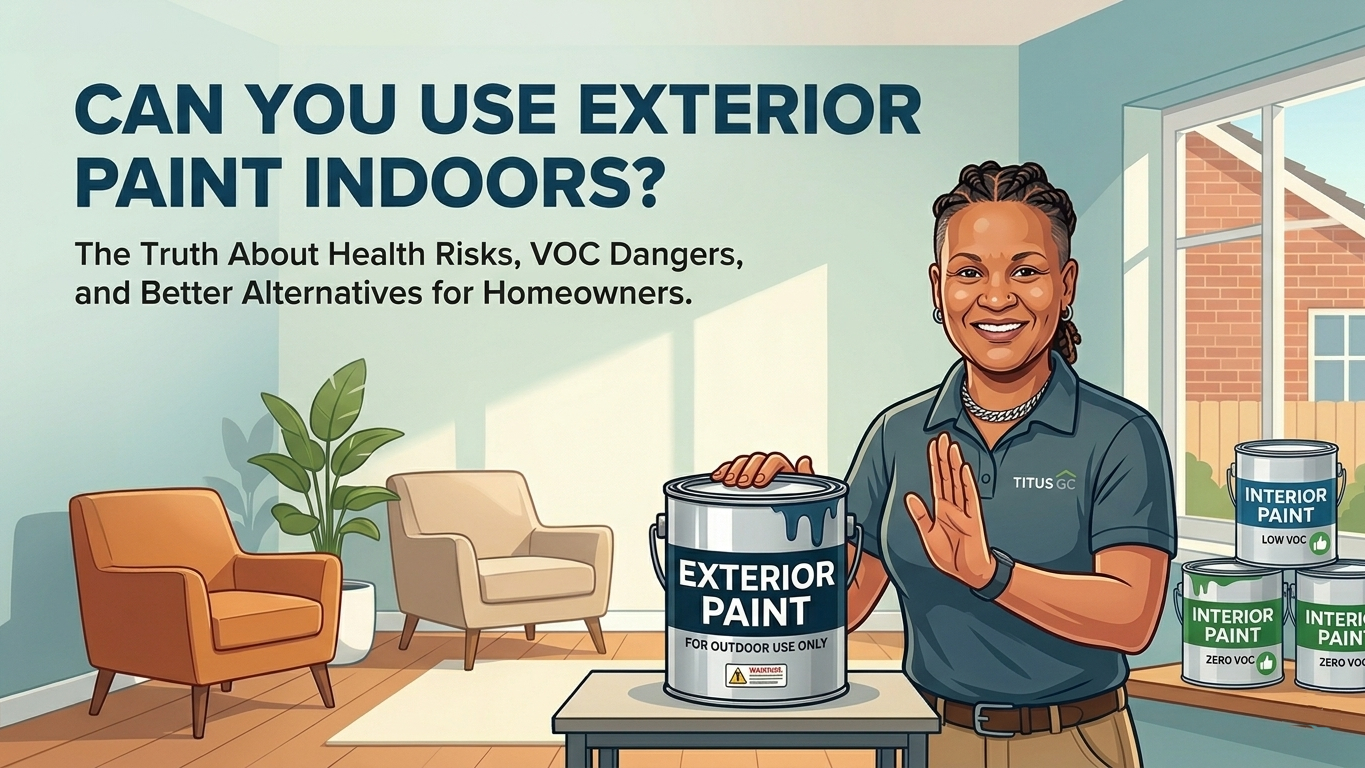
Can You Use Exterior Paint for Interior? What Every Homeowner Must Know
You've got half a can of exterior paint sitting in the garage, and your living room walls are looking tired. The thought crosses your mind: Can I just use this? Paint is paint, right?
It's one of the most common questions homeowners ask, and the answer is more nuanced than a simple yes or no. Technically, exterior paint will stick to interior walls. But whether you should use it indoors is a very different conversation, one that comes down to your health, your home's air quality, and what happens six months from now when things start going sideways.
In this guide, we're cutting through the confusion. We'll explain exactly what makes exterior and interior paint different, why using exterior paint indoors is a decision most contractors strongly advise against, and what the smarter alternatives look like, so you can make a confident, informed choice.
The Short Answer (For Those in a Hurry)
No , you should not use exterior paint for interior surfaces. While it won't immediately ruin your walls, exterior paint is formulated with chemicals, mildewcides, and UV stabilizers that are designed to off-gas outdoors in open air. When used inside a sealed living space, those compounds linger, creating serious air quality concerns and potential long-term health risks.
That said, there's a lot more you need to know, especially if you already have some applied, or if someone told you it was "basically the same thing."
What Actually Makes Exterior Paint Different from Interior Paint?
Most homeowners assume paint is paint. In reality, the two products are engineered for completely different environments.
Exterior Paint Is Built to Survive the Outdoors
Exterior paint is designed to withstand extreme temperature swings, direct UV exposure, moisture, mold, mildew, and the physical stress of surfaces expanding and contracting through seasons. To handle all of that, manufacturers load it with:
Mildewcides and fungicides, chemical biocides that prevent mold growth on outdoor surfaces
UV absorbers and stabilizers, compounds that prevent fading under direct sunlight
High-VOC binders and resins, flexible polymers that allow the paint film to expand and contract without cracking
Moisture-resistant additives, to repel rain, humidity, and condensation
These aren't neutral ingredients. They're functional chemicals that serve a purpose outside, but become problematic when trapped inside your home.
Interior Paint Is Formulated for You
Interior paints are engineered with indoor living in mind. The focus is on:
Low or zero VOC (Volatile Organic Compound) content, so your family breathes clean air after painting
Washability and scrubbability, because interior walls get touched, splattered, and marked
Color retention without UV defense, since indoor lighting doesn't require the same UV protection
Faster curing in low-ventilation environments, designed to off-gas quickly in enclosed spaces
The difference isn't cosmetic. It's chemical. And it matters a great deal when you're spending time in that room every single day.
5 Real Risks of Using Exterior Paint on Interior Walls
1. Dangerous Off-Gassing in Enclosed Spaces
This is the biggest concern, and the one most people underestimate.
Exterior paint has significantly higher VOC levels than interior paint. VOCs (Volatile Organic Compounds) are chemicals that evaporate at room temperature, releasing gases like benzene, formaldehyde, and toluene into the air you breathe.
Outdoors, those gases dissipate almost instantly in open air. Indoors, they have nowhere to go. The EPA has found that indoor VOC concentrations can be 2 to 5 times higher than outdoor levels, and in a freshly painted room with exterior paint, that number climbs even higher.
Health effects of VOC exposure indoors include:
Headaches and dizziness
Nausea and eye/throat irritation
Respiratory complications, especially in children and those with asthma
Long-term exposure linked to liver and kidney damage, and in extreme cases, certain types of cancer
This isn't fearmongering; it's documented by the EPA, OSHA, and the American Lung Association. The risk is real, and it's why interior paint formulations exist in the first place.
2. The Smell Doesn't Just Go Away
One of the first things people notice after applying exterior paint indoors is that the smell persists far longer than expected, sometimes for weeks. That lingering odor is VOC off-gassing. It's your body telling you something isn't right about the air.
Interior paints are formulated to cure and off-gas rapidly in enclosed environments. Exterior paints are not. Some additives in exterior coatings can take months to fully cure indoors, leaving a persistently unpleasant odor and ongoing exposure risk.
3. The Finish Won't Look Right
Exterior paint is designed to be applied on rough, porous, or weathered surfaces in outdoor conditions. When applied to interior drywall or plaster, it often:
Dries unevenly or too quickly, creating lap marks
Has a different sheen profile that looks "off" compared to standard interior finishes
Shows brush and roller marks more prominently
Doesn't level as smoothly because it's not designed for fine interior surfaces
You might save money on the front end, but spend more correcting an unsatisfying finish.
4. It Doesn't Wash or Clean Like Interior Paint
One of the most overlooked differences: interior paints are formulated to be scrubbed. Whether it's crayon on a bedroom wall or a cooking splatter in the kitchen, interior paint holds up to cleaning.
Exterior paint's surface chemistry is optimized for weather resistance, not scrub resistance. Wiping it down can cause the finish to degrade, chalk, or lift, meaning your walls look worn faster despite being freshly painted.
5. It May Violate Indoor Air Quality Standards in Rentals or Commercial Spaces
If you're a landlord or own a commercial property, using high-VOC exterior paint indoors may put you in violation of building codes or indoor air quality standards that vary by state. In Maryland, for example, where emissions and air quality regulations are actively enforced, this can create real liability.
When Homeowners Are Most Tempted to Use Exterior Paint Indoors
Understanding the "why" helps avoid the mistake. Here are the most common scenarios:
"I have leftover exterior paint from a recent project." Leftover paint feels like wasted money if you throw it out. But using it in the wrong place costs more in the long run, whether that's health consequences, a redo, or a professional correction job.
"Someone at the hardware store said it would be fine." This advice is more common than it should be. "It'll stick" and "it's safe" are two very different statements. Yes, it will adhere. No, it isn't the right choice.
"It was on sale, and I grabbed a few gallons." Exterior paint sometimes goes on clearance. The savings aren't worth the risk when you're dealing with respiratory health and indoor air quality.
"The garage and basement don't really count as 'inside,' do they?" Attached garages and basements do share air circulation with your living spaces. Off-gassing in those areas migrates into the rest of your home through HVAC systems, door gaps, and natural airflow.
What to Use Instead: A Quick Interior Paint Guide
If you're planning an interior painting project, here's how to choose the right product:
By Room Type
Living Rooms & Bedrooms: Flat or eggshell finish, low-VOC or zero-VOC formulation. Brands like Benjamin Moore Aura, Sherwin-Williams Harmony, or Behr Premium Plus are popular choices.
Kitchens & Bathrooms: Satin or semi-gloss finish for moisture resistance and washability. Look for paints specifically labeled "kitchen and bath", they contain mildewcides that are safe for indoor use.
Children's Rooms: Zero-VOC is non-negotiable. Look for paints certified by GREENGUARD Gold, which sets strict limits on chemical emissions.
Basements: Use an interior paint with moisture-blocking properties (not exterior paint). Kilz or Drylok-style primers followed by interior latex paint is the professional standard.
Understanding VOC Levels
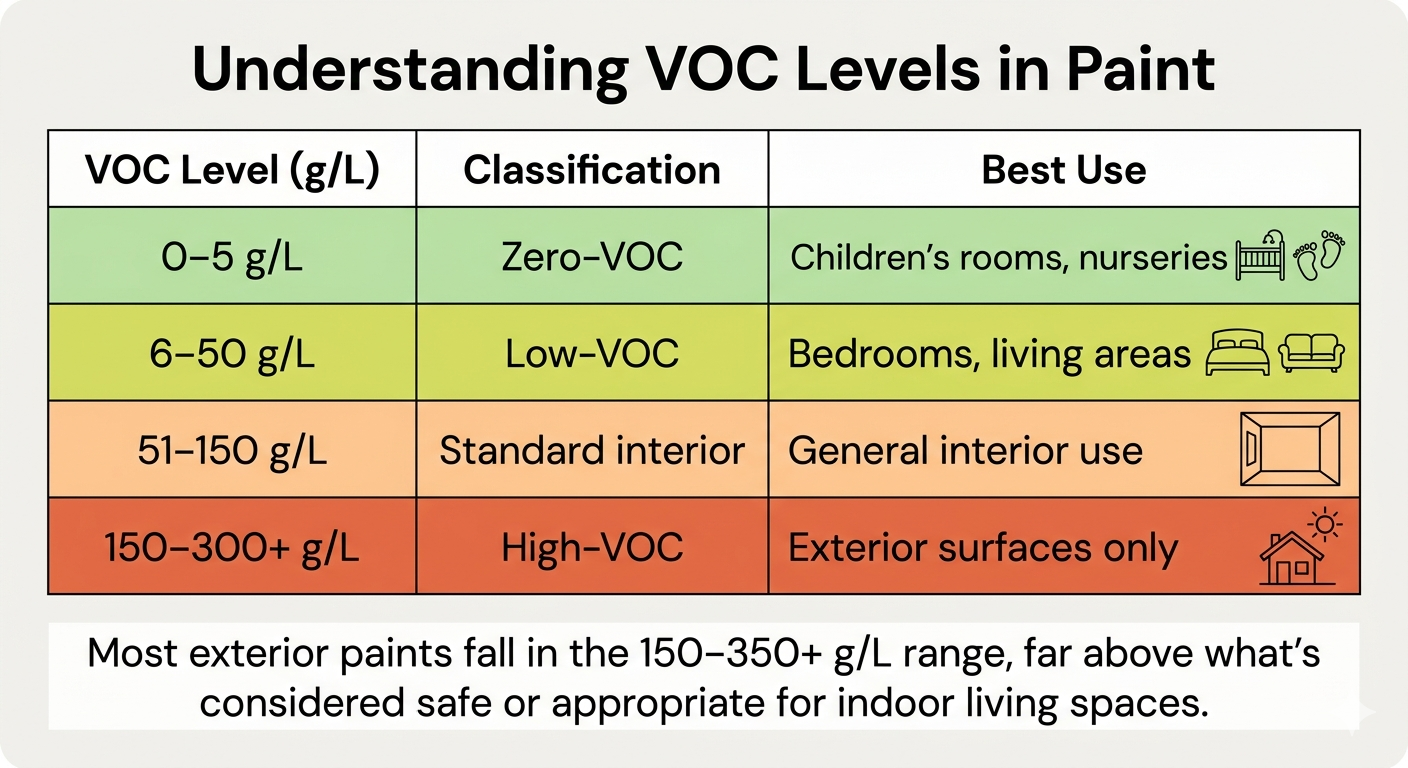
Exterior surfaces only
Most exterior paints fall in the 150–350+ g/L range, far above what's considered safe or appropriate for indoor living spaces.
Cost Comparison: Doing It Right vs. Fixing It Later
One of the main reasons people reach for exterior paint indoors is cost savings. Let's look at what the math actually says.
Using Interior Paint (Doing It Right):
Premium zero-VOC interior paint: $45–$75 per gallon
Average room (400 sq ft): 2 gallons needed
Total material cost: $90–$150
Professional labor (if hired): $300–$600 per room
Total: $390–$750
Using Exterior Paint Indoors (Short-Term "Savings"):
Exterior paint: $35–$65 per gallon (similar or same cost)
Material "savings": $0–$20 per gallon at most
Cost to strip, prime, and repaint after poor results or smell complaints: $500–$900 per room
Potential HVAC cleaning from VOC contamination: $200–$600
Medical costs if family members experience VOC-related symptoms: Variable
Realistic total: $700–$1,500+
The "savings" from using exterior paint indoors evaporate quickly when you factor in correction costs. There is no real financial upside.
6 Signs Your Interior Walls Actually Need Professional Repainting
While you're thinking about paint, it's worth knowing when your walls genuinely need attention, and when a fresh coat (done correctly) makes a measurable difference.
1. Paint is chalking, peeling, or flaking. This indicates the existing coat has failed and is no longer bonded to the substrate. A fresh coat won't fix it without proper surface prep first.
2. Color has faded noticeably near windows; UV exposure through glass fades interior paint over time. Rooms with large windows typically need repainting every 5–7 years.
3. You notice dark spots or staining, which could indicate mold growth beneath the surface. Do not paint over mold; it needs to be remediated first, or it will return through the new coat.
4. The walls feel rough or bumpy. Old paint builds up texture over multiple coats. After 3–4 layers, walls should be sanded and skim-coated before repainting.
5. You smell musty or chemical odors from the walls, A sign of moisture intrusion or, in some cases, prior use of inappropriate paint products that haven't fully cured.
6. You're preparing to sell your home. Fresh interior paint is one of the highest-ROI investments before listing. Homes with freshly painted interiors sell up to 10% faster, according to real estate market data.
Frequently Asked Questions (FAQs)
Can you use exterior paint for interior walls in a garage?
An attached garage shares air with your living space through ventilation gaps, door sweeps, and HVAC. While a garage may have better ventilation than a bedroom, exterior paint still off-gases toxic compounds that can migrate into your home. Interior-grade paint designed for high-moisture environments is the better choice even in garages.
What happens if I have already used exterior paint inside my house?
First, maximize ventilation immediately, open windows, run fans, and if possible, run an air purifier with a HEPA and activated carbon filter. Avoid prolonged exposure to the painted area until the smell fully dissipates. Monitor for persistent odors (weeks, not days) as a sign of ongoing off-gassing. If you or family members experience headaches, nausea, or respiratory issues, vacate the space and consult a professional about proper remediation, which may include stripping and repainting with appropriate interior products.
Is exterior paint toxic when dry?
Once fully cured outdoors, exterior paint poses minimal risk. Indoors, the problem is that the curing process, and associated off-gassing, takes significantly longer without proper airflow. In a sealed room, the paint can continue releasing VOCs for weeks or even months before it's considered fully cured. Dry to the touch does not mean safe to breathe around.
Can exterior paint be used in a bathroom since bathrooms need moisture protection?
This is a common misconception. Interior paint designed specifically for kitchens and bathrooms already includes mildewcide additives and moisture-resistant formulations, without the harmful outdoor-grade chemicals. Look for paint labeled "kitchen and bath" or "high humidity interior," and you'll get the moisture protection you need safely.
Does exterior paint last longer than interior paint?
Outdoors, yes, exterior paint is engineered for longevity in harsh conditions. Indoors, the equation flips. Interior paint is formulated to bond properly with drywall and plaster, resist washing, and maintain color under artificial light. Exterior paint indoors may actually fail faster because it's designed for a different substrate and application environment.
Is there any type of exterior paint that's safe to use indoors?
Some exterior paints marketed as "low-VOC" are safer than traditional formulations, but even these are not intended for indoor use. The mildewcide and UV-stabilizer chemistry still poses indoor air quality risks. There is no exterior paint currently on the market that is recommended as a safe substitute for interior paint.
How much does it cost to repaint a room with proper interior paint?
Professional interior painting typically costs between $300–$800 per room for standard-sized rooms (10x12 to 14x16 feet), including labor and materials. Larger rooms or spaces requiring extensive prep work (patching, priming, multiple coats) may run $800–$1,500. DIY costs for materials alone range from $80–$200 depending on paint quality and room size.
Should I hire a professional painter or DIY my interior painting?
DIY is reasonable for straightforward repaints on smooth, well-prepped walls. Hire a professional when: walls need significant repairs or skim-coating, you're dealing with high ceilings or two-story spaces, you want precise cut lines around trim and molding, or you need the job done quickly and cleanly before a move or sale. Professionals also catch underlying issues, like moisture or mold, that untrained eyes often miss.
How do I know what type of paint is already on my walls?
Wet a cotton ball with rubbing alcohol and rub it against the wall. If paint transfers to the cotton ball, it's latex (water-based). If nothing transfers, it's oil-based. This matters because applying latex paint over oil-based paint without proper priming can cause peeling and adhesion failure.
Can a painting contractor tell if exterior paint was used indoors?
Yes. An experienced contractor can typically identify exterior paint used indoors through visual clues (unusual sheen, chalking, finish texture), smell, and, in some cases, a VOC meter. If you're not sure what was used in your home and you're experiencing air quality concerns, a contractor can assess and recommend the appropriate remediation steps.
Conclusion: Spend Wisely, Breathe Safely
The bottom line is straightforward: you can use exterior paint for interior walls, but you shouldn't. The cost savings are minimal at best and illusory at worst, and the health and air quality risks are real , especially in homes with children, elderly residents, or anyone with respiratory sensitivities.
Good interior painting isn't just about aesthetics. It's about applying the right product to the right surface in the right environment. Interior paints have come a long way; modern zero-VOC formulations deliver beautiful, durable finishes without sacrificing the air quality your family deserves.
If you're unsure what's on your walls, dealing with persistent odors from a previous paint job, or ready to refresh your home with a proper interior paint project, Titus General Contractor Inc is here to help. Our team serves homeowners across Bowie, Prince George's County, Montgomery County, and surrounding Maryland communities with painting and renovation work done right the first time.
Don't guess, get it done right.
Ready to schedule a consultation? Contact Titus GC today or request a free estimate, and let's talk about what your home actually needs.

TESTIMONIALS
HEAR FROM SATISFIED CLIENTS

Delivering excellence in construction and renovation with a commitment to quality craftsmanship and customer satisfaction in Bowie, Maryland.
HOURS OF OPERATION
MON - FRI 9:00AM - 7:00PM
SAT - By Appointment Only
SUN - Closed
ACCREDITATION
Licensed
Bonded
Fully Insured MHIC #135437
CONNECT


© 2026 Titus General Contractor Inc. All Rights Reserved.