
BLOG POSTS

The Hidden Dangers of "Drying It Yourself" After a Leak or Flood
You dealt with the leak. You mopped up the water. You pointed two box fans at the wet area, threw some towels down, and told yourself it would be dry by morning.
That decision is one of the most expensive mistakes a homeowner can make.
The floor looks dry. The wall feels dry to the touch. But inside the drywall, inside the subfloor, inside the sill plate sitting directly on your foundation, the moisture is still there. It has not evaporated. It has not gone anywhere. It is sitting in the dark, in the warmth, exactly where mold needs it to be.
This guide explains exactly what happens inside your walls after a water event, why surface drying does not solve the problem, and what the difference is between a $400 service call and a $15,000 mold remediation project.
Why "It Looks Dry" Is the Most Dangerous Phrase in Water Damage
The surface of drywall can feel completely dry to the touch while the gypsum core holds significant moisture. Hardwood floors can look flat and undamaged on top while the subfloor underneath has been saturated for days. Carpet can feel dry underfoot while the foam padding beneath it remains soaking wet.
This is not an accident of physics. It is how building materials behave.
Every material in your home has a different rate of moisture absorption and evaporation. The outer surface always dries first because it is in contact with moving air. The interior layers, the ones that matter structurally, are insulated from airflow by the very materials surrounding them.
A box fan pointed at a wet wall is moving air across a surface. It is not moving air through a wall cavity. It has no effect whatsoever on moisture trapped between the drywall and the framing behind it.
Section 1: Where Moisture Actually Goes After a Leak
Understanding where water travels after an event is what separates a homeowner who makes a smart decision from one who discovers mold six weeks later.
Inside Drywall
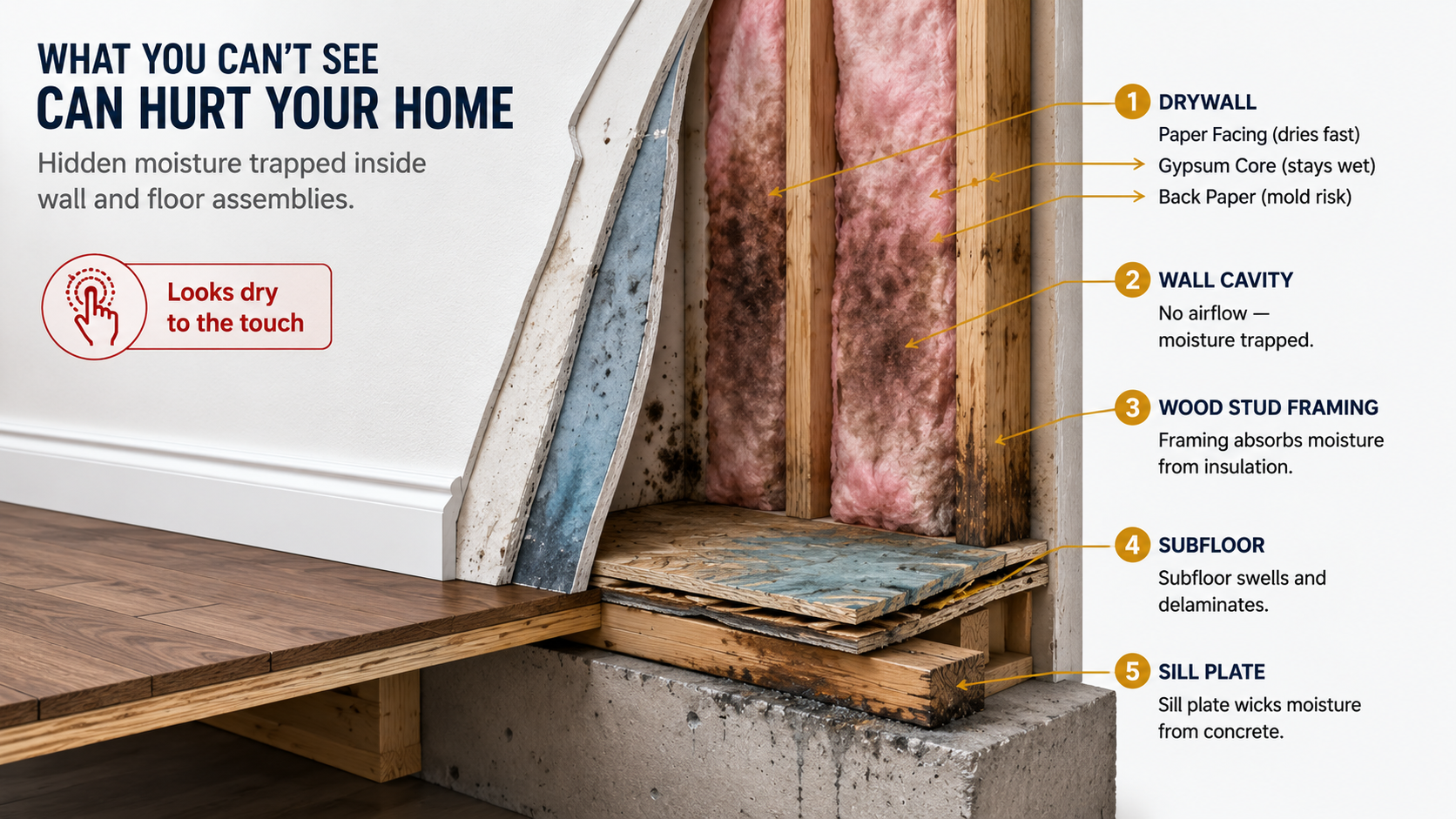
Standard drywall (gypsum board) is approximately 90% gypsum, a naturally porous mineral that absorbs water rapidly. When water contacts drywall, the following happens in sequence:
The paper facing absorbs first. This is the layer you see and touch. It can feel damp or even wet and dry relatively quickly with airflow.
The gypsum core absorbs next. This is the structural layer. Gypsum is highly hygroscopic, meaning it actively draws moisture inward. Once the core is saturated, surface drying has zero effect on it because air cannot penetrate the gypsum to carry moisture out.
The back paper facing absorbs last. This is the layer facing the wall cavity. Moisture trapped here creates the ideal environment for mold growth because it sits in a dark, enclosed space with no airflow whatsoever.
A wall that feels dry on the surface can hold moisture in its core for weeks without professional drying equipment. During those weeks, mold is actively colonizing the material from the inside out.
Inside Subfloors
The subfloor is the structural layer beneath your finished flooring, whether that is hardwood, tile, carpet, or vinyl. It is typically made of plywood or OSB (oriented strand board), and both materials are extremely vulnerable to moisture.
Plywood delaminates when wet. The layers of wood veneer bonded with adhesive begin to separate when moisture penetrates between them. This damage is often invisible from above until the floor becomes soft or springy underfoot.
OSB swells and crumbles. OSB is particularly sensitive to moisture. Once it absorbs water and begins to swell, it does not return to its original dimensions when it dries. Dried OSB that was previously wet is permanently weaker than it was before.
Moisture migrates downward. Water that saturates a subfloor does not stay there. It moves into the joist cavities below, saturating the top surface of the floor joists and any insulation packed between them. At that point, the scope of damage has expanded to structural framing.
Inside Sill Plates
The sill plate is the piece of lumber that sits directly on top of your foundation wall, forming the bottom of your home's wood framing. It is almost always pressure-treated, but pressure treatment does not make wood waterproof.
The sill plate is the most dangerous location for unaddressed moisture. For several reasons:
It sits on concrete, which wicks moisture upward through capillary action
It has minimal airflow around it in most construction
Moisture damage here is almost never visible from inside the living space
Rot and mold in the sill plate can compromise the structural connection between the foundation and the wall framing
Sill plate moisture is the silent failure. By the time it becomes visible or noticeable, significant structural damage has already occurred.
Inside Wall Cavities
The hollow space between your interior drywall and your exterior sheathing is a closed system. There is no airflow in a wall cavity under normal conditions. That is by design for thermal performance.
When moisture enters this space, it has nowhere to go. It condenses on the cooler exterior sheathing surface, it saturates the insulation (which cannot dry without airflow), and it sits in contact with the wood framing. The conditions for mold growth are essentially perfect.
This is why professional structural drying uses equipment that reaches inside the cavity, not just equipment that moves air across the surface.
Section 2: What Household Fans and Towels Actually Do
Let's be precise about this, because understanding the limitation is what changes the decision.
What a Box Fan Does
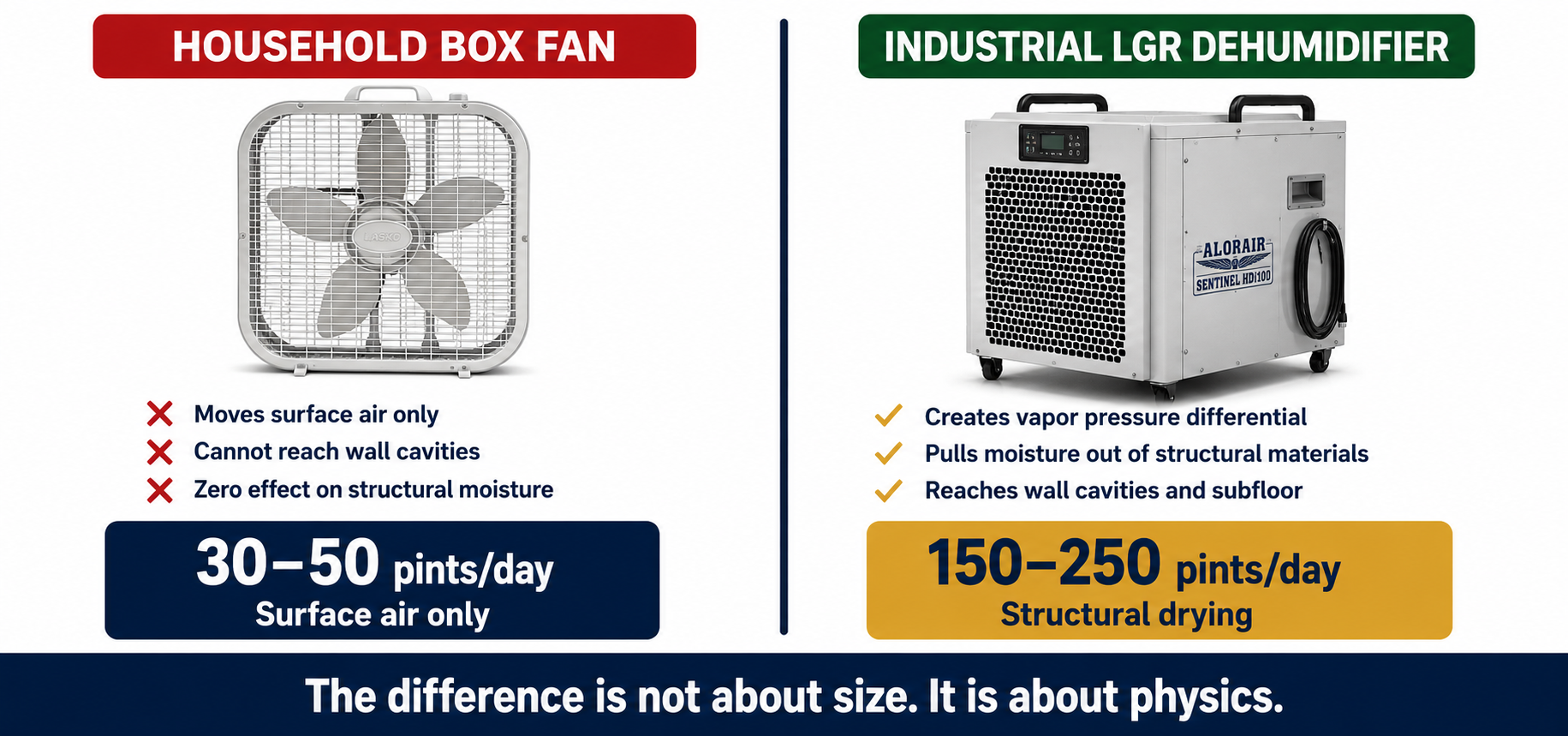
A standard box fan or oscillating fan moves air. That is its function. Moving air across a wet surface does accelerate evaporation from that surface, which is why fans feel cooling and why hanging laundry in front of a fan dries it faster.
The limitation is the word "surface."
What a Box Fan Can Dry What a Box Fan Cannot Reach Top layer of carpet Carpet padding beneath Surface of hardwood floor Subfloor below the hardwood Face paper of drywall Gypsum core of drywall Exposed concrete surface Moisture inside concrete pores Top of an area rug Moisture absorbed into the floor beneath Any surface directly in the airstream Anything inside a wall cavity
A box fan cannot create negative pressure inside a wall cavity. It cannot pull moisture out of gypsum board. It cannot reach the joist bay beneath a subfloor. Every one of those locations is completely unaffected by a fan pointed at the wall.
What Towels Do
Towels are absorbent materials. They are excellent at removing liquid water from a surface. They have zero effect on moisture that has already been absorbed into a building material.
Pressing a towel against wet drywall does not pull moisture out of the gypsum core. Laying towels on a wet floor does not draw moisture out of the subfloor. Towels address liquid water on surfaces. They do not address structural moisture, which is the problem that causes mold.
What a Household Dehumidifier Does
A residential dehumidifier (the type sold at hardware stores for $150 to $300) removes humidity from room air. This is genuinely useful in preventing secondary moisture damage to unaffected areas during a drying event.
The limitation: a household dehumidifier responds to ambient air humidity. It cannot draw moisture out of building materials. It works on the air in the room, not on the moisture trapped inside the walls, floor, and framing.
After a significant water event, the moisture inside structural materials is far greater than the moisture in the air. A residential dehumidifier will run continuously, collect water, and the room will feel more comfortable, while the drywall, subfloor, and framing continue to hold dangerous levels of structural moisture.
Section 3: The Mold Timeline That Nobody Shows You
This is the data that changes the decision for cost-conscious homeowners. Because the question is never really "should I use fans or hire a professional." The question is: "What does waiting cost me?"
How Mold Establishes in Building Materials
Mold is not a surface problem. It is a colonization problem. Mold spores are present in every home and in the outdoor air at all times. They are inert until they have three things: moisture, warmth, and an organic food source.
In a water-damaged wall, all three exist simultaneously. Gypsum paper facing is an organic food source. Wall cavities maintain warmth. And trapped structural moisture provides exactly the water activity level mold needs to germinate and grow.
The timeline once moisture is present in structural materials:
Timeframe What Is Happening Inside Your Walls 0 to 24 hours Moisture absorbs deeper into structural layers. Surface may appear to be drying. No mold yet. 24 to 48 hours Mold spore germination begins in areas with moisture above 19% wood moisture content or RH above 70%. 48 to 72 hours Early mold colonies establish on drywall paper facing and wood framing surfaces inside cavities. 72 hours to 1 week Visible mold growth on surfaces inside wall cavities. Not yet visible from the room. The wall still looks dry. 1 to 2 weeks Mold begins to show through drywall surface as dark staining, bubbling paint, or musty odor. 2 to 4 weeks Widespread colonization of wall cavity, framing, and potentially insulation. Full remediation required. 4 weeks and beyond Structural compromise of paper-faced drywall. Potential rot in wood framing. HVAC contamination risk increases.
The critical insight from this table: mold is growing inside your walls for one to two weeks before you see or smell anything. By the time you notice the musty odor or the dark spot appearing on the wall, you are already in remediation territory.
What Remediation Costs Versus Structural Drying
This is the comparison that makes the decision clear.
Professional structural drying (called within 24 to 48 hours):
Service Typical Cost Range Emergency water extraction $300 to $600 Industrial drying equipment setup (per room, per day) $150 to $300 Moisture monitoring and management (3 to 5 day drying period) $400 to $800 Post-drying inspection and documentation $150 to $300 Total for a single-room water event $800 to $1,800
Mold remediation after DIY drying failure (discovered 2 to 6 weeks later):
Service Typical Cost Range Mold inspection and testing $300 to $700 Containment setup (negative pressure barriers, HEPA air scrubbers) $500 to $1,200 Drywall removal and disposal (per room) $800 to $2,500 Framing treatment and antimicrobial application $600 to $1,500 Insulation removal and replacement $500 to $2,000 Drywall reinstallation and finishing $1,200 to $3,500 Paint and final restoration $400 to $1,000 Total for a single-room mold remediation event $4,300 to $12,400
The math is not complicated. A $1,200 structural drying call versus a $6,000 to $12,000 mold remediation event two months later. The fans cost you more.
And that range does not account for the insurance complexity of mold claims, which are handled differently than initial water damage claims in most policies. Many insurers reduce or deny mold claims when they determine the mold resulted from a gradual condition that could have been prevented with prompt professional drying.
Section 4: What Professional Structural Drying Actually Looks Like
Most homeowners picture a restoration contractor arriving with bigger fans. That is not what structural drying is. The equipment, the process, and the science are fundamentally different from anything available at a hardware store.
Moisture Meters: Seeing Inside the Wall
The first tool a professional structural drying technician uses is a moisture meter. Not to check whether the surface feels wet, but to measure the actual moisture content inside the material.
There are two types used in professional structural drying:
Pin-type moisture meters use two metal probes inserted into the material surface to measure electrical resistance, which correlates to moisture content. They can measure moisture at varying depths depending on probe length. They give precise percentage readings for wood framing and subfloor materials.
Pinless (non-invasive) moisture meters use electromagnetic signals to measure moisture content to a depth of 3/4 inch to 1.5 inches without penetrating the surface. These are used to scan large areas quickly and identify moisture migration patterns that are completely invisible from the surface.
What professionals look for:
Material Safe Moisture Level Elevated Risk Mold-Risk Zone Wood framing / subfloor Below 16% 17 to 19% Above 19% Drywall gypsum core Below 0.5% 0.5 to 1.0% Above 1.0% Concrete subfloor Below 4% 4 to 6% Above 6%
Without a moisture meter, there is no way to know what is actually happening inside the material. Surface appearance tells you nothing. A wall with a moisture reading of 24% in the framing behind it looks completely normal from the room.
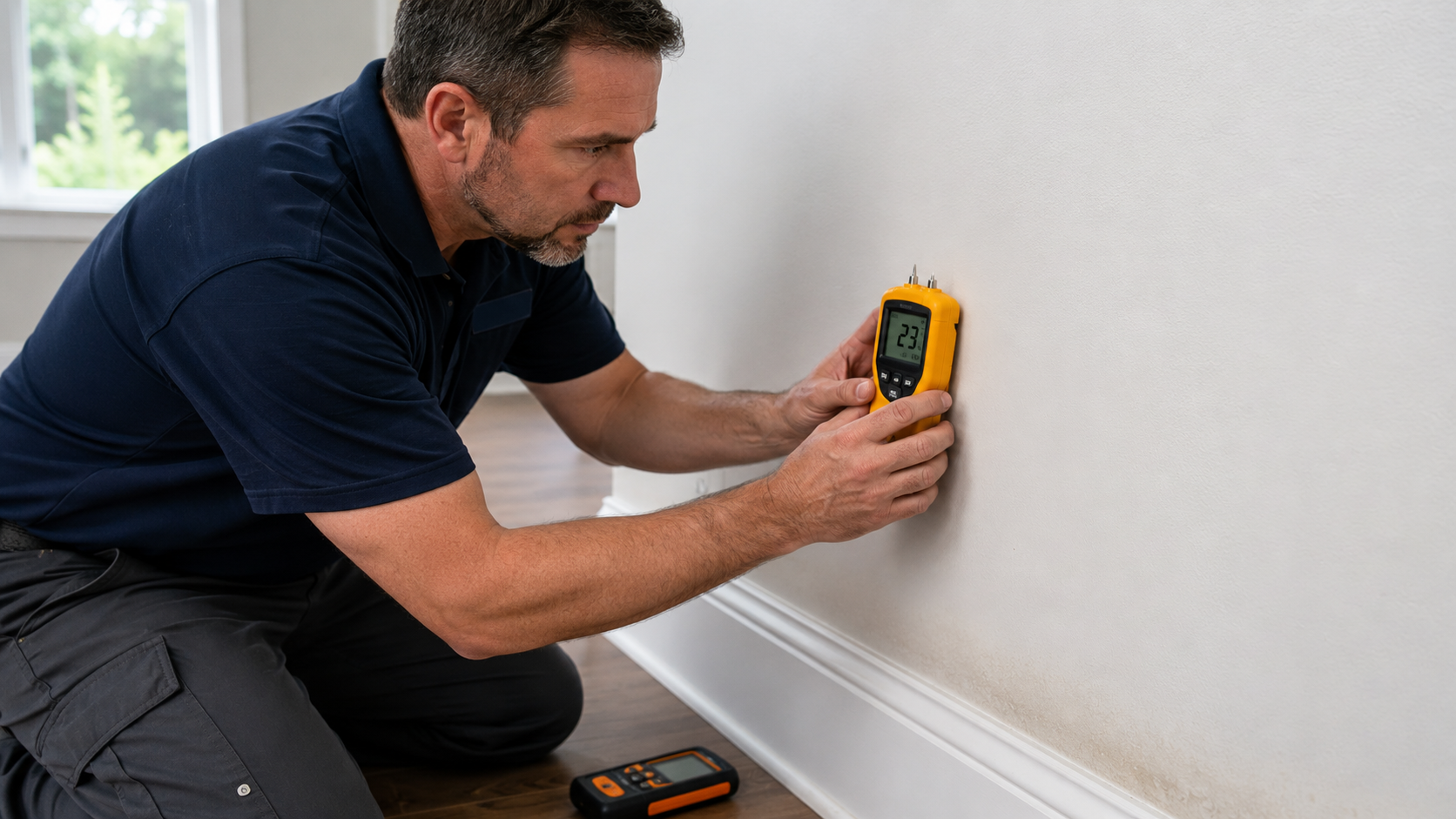
Titus GC's water damage restoration team uses professional-grade moisture meters at the start of every job, throughout the drying period, and at final inspection. Drying is not complete until moisture readings return to safe baseline levels, not until the surface looks or feels dry.
Industrial Dehumidifiers: Pulling Moisture Out of Materials
A professional low-grain refrigerant (LGR) dehumidifier operates at a fundamentally different capacity than a residential unit.
Feature Residential Dehumidifier Industrial LGR Dehumidifier Moisture removal per day 30 to 70 pints 150 to 250 pints Operating humidity range Effective above 60% RH Effective down to 35% RH Effect on structural materials Air only Creates vapor pressure differential that draws moisture out of materials Noise level Quiet (bedroom safe) Loud (industrial equipment) Typical cost to rent Not available to public Professional use only
The vapor pressure differential created by an industrial LGR dehumidifier is the key mechanism. By dramatically lowering the humidity in the room air, it creates a moisture gradient between the wet structural materials and the dry air. Moisture moves from high concentration (inside the wall) toward low concentration (the dry room air), where the dehumidifier captures it.
This is the physics that a box fan cannot replicate. A fan does not lower room humidity enough to create this gradient. Only industrial equipment operating continuously at high capacity achieves the vapor pressure differential needed to extract moisture from inside materials.
Structural Cavity Drying
For walls that have been wet long enough to saturate the cavity, or where moisture readings indicate significant interior moisture, professional drying includes direct cavity drying.
This involves drilling small access holes (typically 1/2 inch to 3/4 inch diameter) into the base of the wall, at intervals of 12 to 16 inches, and injecting warm dry air directly into the wall cavity using an injectidry system or similar equipment.
The access holes are later patched, primed, and painted. The result is a structurally dry wall with minimal visible repair. The alternative, discovering the same wall has active mold six weeks later, requires cutting out large sections of drywall for remediation.
This is not a technique a homeowner can replicate with hardware store equipment. It requires professional tools, moisture monitoring throughout the process, and the judgment to know which walls need cavity drying and which can be dried from the surface.
Thermal Imaging
Professional restoration teams often use infrared thermal cameras as a secondary diagnostic tool. Wet building materials have different thermal signatures than dry materials because evaporating moisture creates temperature differentials that show up clearly on a thermal image.
Thermal imaging allows a technician to scan an entire room in minutes and identify moisture migration patterns that would take hours to map with a moisture meter alone. It is particularly valuable for identifying water that has traveled behind baseboards, under flooring, or into adjacent rooms through wall penetrations.
Section 5: The Specific Situations Where DIY Drying Fails
Not every water event carries the same risk level. Here is how to calibrate honestly.
Low Risk (Surface Drying Often Sufficient)
A small spill on a finished floor that is cleaned up within minutes
A toilet overflow limited to tile flooring that is extracted within one hour
A brief roof leak during a storm that is resolved and the affected ceiling area is small and caught quickly
Any scenario where the water was on the surface for under 30 minutes and did not contact porous materials
Moderate Risk (Professional Assessment Strongly Recommended)
Any leak that was not discovered for more than a few hours
Water that reached carpet, drywall, wood flooring, or cabinetry
A ceiling that shows staining after a roof or plumbing event
Basement flooding from any source, even if quickly extracted
High Risk (Professional Structural Drying Required)
Any event where water was present for more than 12 hours before discovery
Water that reached the wall-floor junction (the base of drywall is the first and fastest area to wick moisture upward)
Flooding in a basement or crawl space
Water that came from above (ceiling leak, second-floor pipe) because it travels through multiple layers before becoming visible
Any situation where a musty smell is present within days of the event, as this indicates mold has already begun
If your situation falls in the moderate or high-risk categories, Titus GC's structural drying team can be on site to assess within hours. A moisture assessment alone, without commitment to a full restoration project, is available and gives you the data you need to make a real decision.
Section 6: What Happens If You Miss It
This section is uncomfortable. But it is the information that actually changes behavior.
Toxic Mold vs. Common Mold
Not all mold is equally dangerous. The mold that develops most commonly in water-damaged building materials in Maryland homes includes Cladosporium, Penicillium, and Aspergillus. These are classified as potential allergens and respiratory irritants, particularly for children, elderly residents, and those with compromised immune systems.
Stachybotrys chartarum, commonly called black mold, develops in conditions of prolonged high moisture (typically 72 to 96+ hours of continuous saturation) on materials with high cellulose content. This includes drywall paper facing and wood framing, exactly the materials at risk in an unaddressed water event.
Black mold exposure is associated with serious respiratory symptoms, neurological effects, and immune system suppression in prolonged exposure scenarios. It is not a DIY remediation situation under any circumstances.
If you discover mold growth in a previously flooded area, the right call is Titus GC's mold remediation service, not a bottle of bleach and a respirator mask.
HVAC Contamination
Here is the risk most homeowners never consider. If mold colonizes a wall cavity or ceiling space that is adjacent to or connected with your HVAC ductwork, mold spores enter the air distribution system. From there, the system distributes spores throughout every room in the house with every heating and cooling cycle.
HVAC contamination from a single water damage event can spread mold to rooms that were never involved in the original incident. The cost of addressing this scenario is dramatically higher than the cost of addressing the original event promptly.
Structural Rot in Framing
Wood framing that remains wet for extended periods does not just grow mold. It rots. Wood rot is the degradation of the cellular structure of the wood by fungi, and it progresses from a cosmetic problem to a structural one faster than most homeowners expect.
A sill plate that has been wet for four to six weeks may show significant rot, compromising its structural connection to the foundation. A floor joist that has been saturated may develop rot that reduces its load-bearing capacity. These are scenarios that move from the category of water damage repair into structural repair, with costs and complexity that increase accordingly.
What Titus GC Does Differently
When Titus GC's water damage restoration team arrives at a water-damaged Maryland home, the process is systematic and documented from the first reading to the final clearance.
Day 1: Assessment and Equipment Setup Moisture mapping of all affected and adjacent areas using professional-grade meters and thermal imaging. Industrial extraction of any remaining standing water. Placement of industrial LGR dehumidifiers and air movers in calculated positions based on the moisture map. Cavity drying equipment installed where indicated.
Days 2 to 5: Active Structural Drying Daily moisture readings at every mapped point. Equipment repositioned as drying progresses. Documentation of readings at each visit. Insurance documentation maintained throughout.
Final Day: Clearance Inspection Final moisture readings at all points confirm return to safe baseline levels. Written clearance documentation provided. Identification of any areas that require further repair work, with honest recommendations and itemized estimates.
The full scope of Titus GC services available after a water event:
Water Damage Repair: Structural drying, extraction, and material repair
Mild Mold Repair: Remediation when mold has already developed
Storm and Flood Damage Repair: Exterior water intrusion events
Insurance Claim Repairs: Documentation and claim support throughout the process
Home Inspection Repairs: Addressing moisture findings from buyer or seller inspections
Vacant Property Make Ready: Water damage restoration for landlords and property managers
Jude Titus, MHIC Licensed Contractor, brings 30+ years of construction experience and 20+ years in Maryland real estate. The team understands that water damage is not just a structural problem. It is a financial decision with long-term implications for your home's value, your insurance position, and your family's health.
Frequently Asked Questions (FAQs)
How long does it take for mold to grow after a water leak?
Mold can begin germinating within 24 to 48 hours under the right conditions: moisture content above the threshold level in an organic material, warmth, and limited airflow. In wall cavities and subfloor spaces, all three conditions exist simultaneously after a water event. Visible mold on surfaces typically appears within one to two weeks, but the colonization has been progressing inside the material for most of that time before it becomes visible.
Can I use a fan and dehumidifier to dry water damage myself?
Fans and household dehumidifiers address surface moisture and ambient air humidity. They cannot extract moisture trapped inside structural materials like drywall gypsum cores, subfloor panels, wall cavity insulation, and wood framing. In a minor event where water was on a hard surface for under 30 minutes, surface drying may be sufficient. For any event involving porous building materials, or water present for more than a few hours, professional structural drying with industrial equipment is required to prevent mold growth.
How do I know if there is moisture inside my walls after a leak?
You cannot determine this visually or by touch alone. A professional moisture meter is the only reliable tool. Signs that suggest interior moisture without a meter include: a musty smell that develops within days of the event, paint bubbling or wallpaper separating from the surface, soft or spongy spots when you press the wall, discoloration appearing from the inside of the material outward, or elevated humidity readings in the room despite apparent surface drying.
What is the difference between an industrial dehumidifier and a household dehumidifier?
An industrial low-grain refrigerant (LGR) dehumidifier removes 150 to 250 pints of moisture per day versus 30 to 70 pints for a residential unit. More importantly, industrial units can operate effectively at very low humidity levels (down to 35% RH), creating the vapor pressure differential needed to pull moisture out of structural materials. Residential units are not designed to operate in this range and lose efficiency as humidity drops. Only industrial equipment creates the conditions necessary for structural drying.
How much does professional water damage drying cost in Maryland?
Professional structural drying for a single-room water event in Maryland typically costs between $800 and $1,800, covering extraction, equipment placement, monitoring across a 3 to 5 day drying period, and final clearance documentation. This compares to $4,300 to $12,400 or more for mold remediation in the same room if the moisture is not properly addressed. Most homeowner's insurance policies cover emergency water damage drying when the damage results from a sudden, accidental event.
Does homeowner's insurance cover professional water damage drying?
Most standard homeowner's insurance policies cover sudden and accidental water damage, which includes the cost of professional extraction and structural drying. Gradual leaks that the homeowner knew about are typically excluded. Insurance companies also generally cover the cost of professional drying when it is done promptly to mitigate further damage. Mold claims that result from failure to promptly mitigate are handled differently and may be partially or fully denied. Calling a professional restoration contractor quickly works in your favor with the claim.
Is it safe to stay in a home while professional drying equipment is running?
In most cases, yes. Industrial drying equipment is loud and generates heat, which may make the affected areas less comfortable. The equipment itself poses no health risk. If mold remediation is also being performed simultaneously, containment barriers and negative pressure systems are used, and some families choose to temporarily relocate during that phase. Your contractor will give you a clear recommendation based on the actual scope of work.
How do I know when my home is fully dry after water damage?
A home is structurally dry when moisture readings at all affected points return to baseline levels: below 16% for wood materials and below 0.5% for drywall gypsum. Surface appearance is not a reliable indicator. Professional structural drying contractors take documented readings at the start and end of the drying process, providing written clearance documentation when the structure reaches safe moisture levels. Without that documentation, "dry" is a guess.
What is a sill plate and why does moisture damage it?
The sill plate is the piece of lumber that sits directly on top of your foundation wall, forming the bottom of your home's wood framing. It is at particularly high risk for moisture damage because it sits on concrete, which naturally wicks moisture upward through capillary action. It also has minimal airflow around it in most home construction. Moisture damage to the sill plate can compromise the structural connection between the foundation and the wall framing above it, which moves the problem from water damage repair into structural repair.
When should I call a mold remediation professional versus a water damage restoration contractor?
Call a water damage restoration contractor immediately after any significant water event, before mold has had time to develop. If you already see or smell mold, or if a moisture event was discovered more than 72 hours after it occurred, a mold assessment should be part of the initial consultation. Titus GC handles both water damage restoration and mold remediation, so a single call covers both scenarios.
Conclusion: The Fans Feel Like Action. They Are Not.
There is a reason pointing a fan at a wet wall feels productive. It feels like doing something. It feels like taking control of a stressful situation. And for the first few hours while you are waiting to figure out your next step, it is not harmful.
But stopping there is where the problem begins.
Every hour that structural moisture sits inside your walls is an hour closer to a mold remediation project that costs five to ten times more than the drying service would have. The moisture meter does not lie. The mold timeline does not negotiate. And the math on this decision is not close.
The homeowners who call a professional within the first 24 hours consistently have better outcomes: lower total costs, cleaner insurance claims, no mold events, and no structural repairs that were preventable. The homeowners who wait and hope the fans handle it consistently discover mold, file complicated claims, and pay significantly more.
Titus GC serves homeowners across Bowie, Prince George's County, Montgomery County, and the surrounding Maryland area. Our structural drying team deploys industrial equipment, monitors moisture levels with professional tools, and provides written clearance documentation that protects your home and your insurance claim.
Do not wait to find out if the fans were enough.
Schedule a moisture assessment and structural drying consultation or call 443-551-2181 today. Monday through Friday, 9:00 AM to 7:00 PM. Saturday by appointment.
Titus General Contractor Inc | Licensed · Bonded · Fully Insured · MHIC #135437 Serving Bowie, MD · Prince George's County · Montgomery County and surrounding areas 📞 443-551-2181 · 📍 12530 Fairwood Pkwy, Bowie, MD Hours: Mon-Fri 9:00 AM to 7:00 PM · Sat by Appointment

TESTIMONIALS
HEAR FROM SATISFIED CLIENTS

Delivering excellence in construction and renovation with a commitment to quality craftsmanship and customer satisfaction in Bowie, Maryland.
HOURS OF OPERATION
MON - FRI 9:00AM - 7:00PM
SAT - By Appointment Only
SUN - Closed
ACCREDITATION
Licensed
Bonded
Fully Insured MHIC #135437
CONNECT


© 2026 Titus General Contractor Inc. All Rights Reserved.