
BLOG POSTS
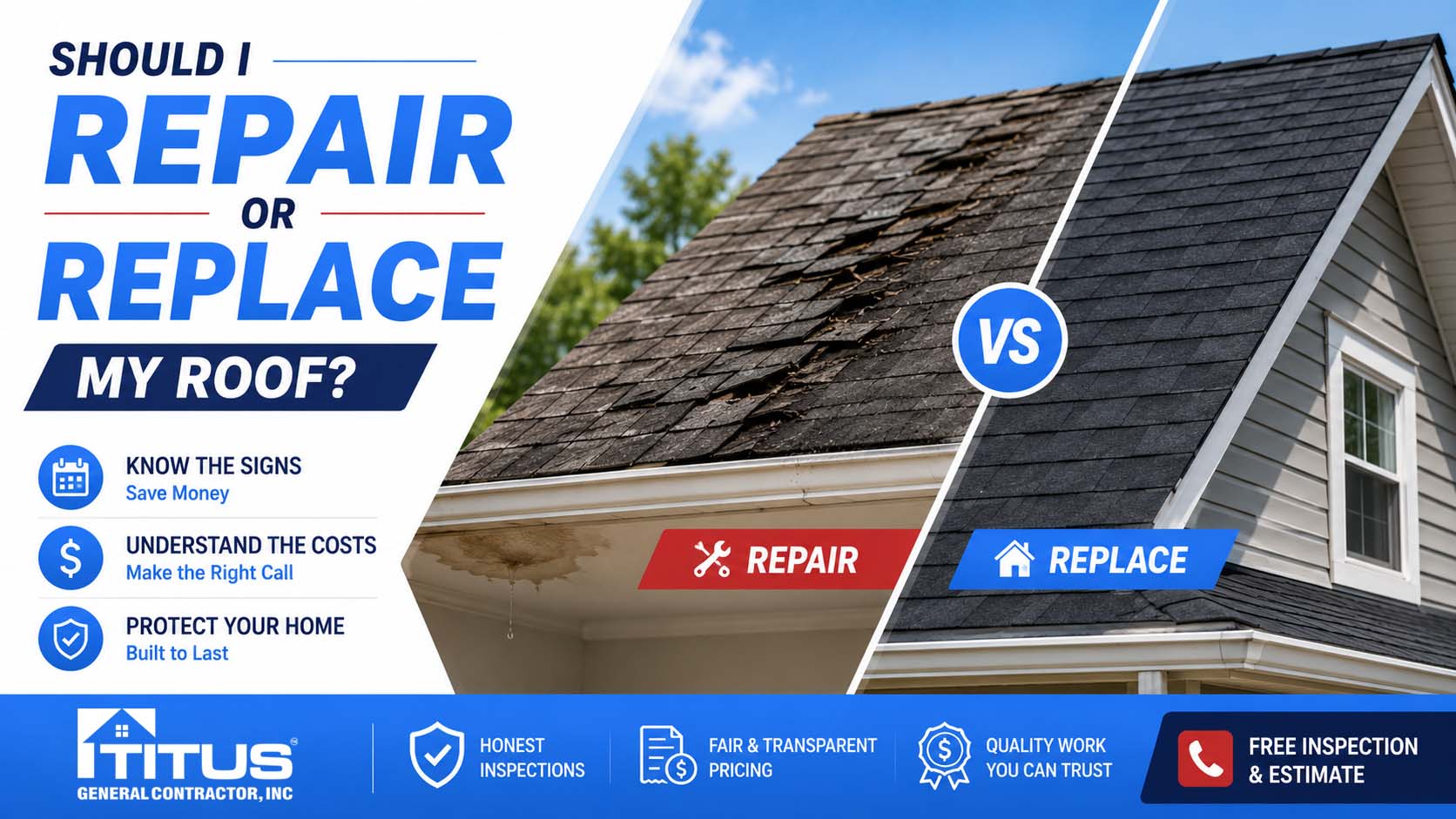
Should I Repair or Replace My Roof? The Honest Homeowner's Checklist
Home Improvement & Decision Guides Read Time: ~12 min
You noticed a water stain on the ceiling last Tuesday. By Thursday it had spread. Now it is Sunday night, you are staring at a bucket on the kitchen floor, and you have one pressing question: is this a quick fix or a full replacement?
That question is more consequential than most homeowners realize. Call it wrong in either direction and you lose. Patch a roof that needed replacement and you will be back on the phone with a contractor in 18 months. Replace a roof that had years of life left and you spent money that was not necessary yet.
This checklist gives you the honest framework contractors use to make that call, so you walk into any inspection conversation already knowing what you are looking at.
All cost figures reflect current Maryland market pricing. For a precise estimate on your specific property, a professional inspection is always the most reliable starting point.
The Short Answer (For Those Who Need It Now)
Repair when the damage is genuinely localized, your roof is under 15 years old, and this is not a recurring pattern.
Replace when the roof is 20 or more years old, when you have repaired the same or nearby areas multiple times, or when interior damage (water stains, attic mold, soft decking) indicates systemic failure rather than an isolated issue.
Everything in between requires a closer look. That is what the rest of this guide is for.
Section 1: The 5 Factors That Determine Repair or Replace
Every roofing contractor worth hiring runs through the same core assessment before making a recommendation. Here are the five factors that carry the most weight.
Factor 1: The Age of Your Roof
Age is the single most predictive factor in the repair vs. replace decision. Every roofing material has a projected lifespan, and once a roof passes roughly 80% of that lifespan, the math starts favoring replacement over repair.
Roofing Material Expected Lifespan Repair-Friendly Zone Replace Zone 3-Tab Asphalt Shingles 15 to 20 years Under 12 years old 15 years or older Architectural / Dimensional Shingles 25 to 30 years Under 18 years old 22 years or older Metal Roofing (standing seam) 40 to 70 years Under 30 years old 50+ years or showing corrosion Flat / Modified Bitumen 10 to 20 years Under 10 years old 15 years or older Wood Shake 20 to 30 years Under 15 years old 20 years or older
If you do not know the age of your roof, check your home inspection report from when you purchased the property. A professional roof inspection from Titus GC can also date the installation based on material condition and wear patterns.
Factor 2: The Extent of the Damage
Localized damage on a young roof is a repair. Widespread deterioration on an aging roof is a replacement. The challenge is honestly assessing which one you are dealing with.
Localized damage covers a clearly defined area: one section of wind-lifted shingles, flashing failure at a single penetration, or a small number of cracked shingles in one spot. Repairing a targeted area on a roof that is otherwise performing well is reasonable and cost-effective.
Widespread damage is different. If shingles across multiple sections are curling, cracking, or losing granules, the underlying cause is general material aging, not a single event. Patching one area leaves the remaining deterioration untouched.
Factor 3: The Repair History
This is the factor most homeowners underweight. If you have called a roofer for the same roof more than twice in the past three years, the roof is not having bad luck. It is failing.
A pattern of recurring repairs is a systemic signal. Each patch fixes the visible symptom without addressing the underlying cause: a roof system past its reliable service window. At that point, continuing to repair is more expensive over time than replacing.
If you have filed multiple insurance claims for storm or weather damage on the same roof in recent years, that history is worth factoring into the replacement calculation as well.
Factor 4: The Interior Condition of Your Home
The ceiling stain you noticed is a symptom. The real question is how far the water has traveled before you noticed it.
Check these areas before calling anyone:
Attic: Active moisture, soft or discolored decking, mold growth on rafters or sheathing, or visible daylight through the roof boards are all serious findings
Ceiling and upper walls: Staining in multiple rooms or along wall-to-ceiling joints suggests water is traveling, not pooling in one spot
Insulation: Wet, compressed, or visibly moldy attic insulation indicates prolonged moisture exposure
When water has reached the attic insulation or caused mold growth on structural components, the damage often extends beyond the roof covering itself. Titus GC's team assesses not just the shingles but the full picture, including whether water damage repair or mild mold remediation is needed alongside the roofing work.
Factor 5: The 50% Rule
This is the contractor's most practical decision tool.
If the cost to repair the roof exceeds 50% of what a full replacement would cost, replace it.
Here is why the math works that way. A repair that costs 50% of replacement buys you only part of the roof's remaining life. A replacement buys you a completely new system with a 20 to 30-year horizon, a transferable warranty, and documented capital improvement status that works in your favor when you sell.
The numbers only make sense for repair when the project costs a fraction of replacement and the underlying roof structure has substantial useful life remaining.
Section 2: How to Know If You Need a Roof Repair (Visual Checklist)
You do not need to get on the roof to gather useful information. A ground-level assessment and a quick attic check can tell you a great deal before any contractor arrives.
From the Ground (Exterior)
Walk the perimeter of your home on a clear day and look for:
Shingles that are curling at the edges or cupping upward (a sign of age-related shrinkage or moisture damage beneath)
Dark streaks or staining running down the roof face (algae growth, common in Maryland's humid climate)
Visible bare patches where granules have washed away (granule loss exposes the asphalt layer to UV degradation)
Missing shingles in isolated spots versus missing shingles across multiple sections
Sagging areas along the ridge line or mid-slope (indicates decking or structural issues below the shingles)
Damaged or separated flashing at chimneys, skylights, vents, and wall transitions
Gutters full of granules after a rain (normal for new roofs; a warning sign on aging ones)
If your gutters are pulling away from the fascia, deteriorating, or no longer channeling water properly, that is a separate but related issue. Titus GC's gutter installation and repair service addresses gutter problems that contribute to roof edge and soffit damage.
From the Attic (Interior)
With a flashlight, look for:
Light coming through roof boards where there should be none
Water staining or dark streaks on rafters and decking
Soft, spongy, or visibly rotted decking boards
Frost in winter on the interior of the roof decking (indicates air and moisture infiltration)
Mold or mildew on any structural surface
Any of the attic findings above qualifies as a finding that warrants a professional inspection, not a DIY patch.
After a Storm
Maryland experiences significant wind events, heavy rain, hail, and occasional ice storms. After any major weather event, check for:
Missing or displaced shingles
Dented or bruised shingles (hail impact leaves circular indentations)
Tree limb or debris impact areas with cracked or punctured shingles
Shifted flashing at any roof penetration
Storm damage that appears localized to one or two shingles may be repaired. Storm damage affecting a large portion of the roof surface may qualify for a full storm damage restoration and a corresponding insurance claim. Document everything with photos before any work begins.
Section 3: How Much Is Roof Repair vs. Full Replacement?
Cost is a major driver of this decision, and knowing realistic numbers before you get a quote puts you in a much stronger position.
How Much Is Roof Repair in Maryland?
Typical roof repair costs in Maryland (2025):
Repair Type Estimated Cost Range Minor shingle replacement (5 to 10 shingles) $150 to $400 Flashing repair (chimney, vent, or skylight) $200 to $600 Moderate section repair (larger shingle area) $400 to $1,200 Valley repair or re-flashing $500 to $1,500 Significant repair (decking damage, multiple penetrations) $1,000 to $3,500 Flat roof patch or seam repair $300 to $1,200
If a contractor quotes you more than $3,500 for a described repair, ask for a full itemized breakdown and request a replacement estimate at the same time. At that cost level, a comparison is always worth having.
How Much Does Roof Replacement Cost in Maryland?
Maryland roof replacement cost ranges (2025):
Home Size 3-Tab Asphalt Architectural Shingles Metal Roofing Under 1,500 sq ft $6,500 to $10,000 $8,500 to $13,000 $14,000 to $20,000 1,500 to 2,000 sq ft $9,000 to $13,500 $11,500 to $17,000 $18,000 to $26,000 2,000 to 2,500 sq ft $11,500 to $17,000 $14,000 to $21,000 $23,000 to $32,000 2,500 to 3,500 sq ft $15,000 to $23,000 $18,500 to $28,000 $29,000 to $42,000
These figures reflect current material and labor costs in the Prince George's County and Montgomery County markets. Final pricing depends on roof pitch, complexity, decking condition, and material selection.
The Hidden Cost of Delaying a Replacement
This is the number most homeowners never see on a quote but always feel later.
When a failing roof is patched repeatedly instead of replaced, water continues to infiltrate. That moisture damages attic insulation, reduces its R-value, and drives up energy costs. It softens decking and compromises structural framing. It creates the conditions for mold growth that requires professional remediation.
By the time a homeowner finally replaces the roof, they often also need water damage repair, insulation replacement, and sometimes drywall or structural work. The roof was never the only cost.
Section 4: The 8 Red Flags That Mean Replace, Not Repair
This list ends the debate. If your roof shows any of the following, a repair will not solve the problem.
1. The roof is 20 or more years old on standard asphalt shingles. At that point, the material's reliable service window has closed regardless of how it looks from the ground.
2. Multiple layers of shingles are already installed. Most Maryland homes are limited to two layers by code. If two layers are already present, any new roofing requires a full tear-off and replacement.
3. The roof deck is soft, spongy, or visibly sagging. Decking failure means the structural substrate beneath the shingles has been compromised by moisture. No surface repair addresses this.
4. Shingle granule loss is widespread across the roof surface. Granules protect the asphalt layer from UV exposure. Once they are gone across the majority of the surface, the material degrades rapidly and unevenly.
5. You can see daylight through the roof boards from the attic. This is not a repair situation. Structural gaps in the roof assembly require full replacement.
6. The same area has been repaired twice or more. If a specific section has been addressed multiple times, the surrounding material has already degraded to the point where holding repairs is no longer reliable.
7. Mold is present in the attic on structural surfaces. Active mold on rafters or decking indicates that moisture has been infiltrating consistently enough to establish growth. This requires both mold remediation and a root-cause fix at the roof level.
8. The repair quote exceeds 50% of replacement cost. Apply the 50% Rule. The numbers make the decision for you.
Section 5: When a Repair Truly Is the Right Call
Repair is the correct answer in specific, well-defined circumstances. Replacing a roof that did not need replacement is as costly a mistake as delaying one that did.
Repair is the right call when:
The roof is under 12 years old on architectural shingles, or under 8 years old on any material
Damage is clearly isolated to one small area with a single identifiable cause (one broken flashing, storm damage to 5 to 10 shingles in one section)
This is the first repair on the roof since installation
Attic inspection shows no moisture infiltration, no mold, and solid decking throughout
A professional inspection confirms substantial remaining useful life
The repair cost is well under 30% of replacement cost
In these cases, a quality repair by a licensed contractor resolves the problem cost-effectively and extends the roof's service window without unnecessary expense.
Section 6: Why a Professional Inspection Settles the Debate
The honest truth: you cannot make this decision reliably from ground level alone.
A licensed inspector evaluates what you cannot see from the yard or from a quick attic glance. They check flashing integrity at every penetration, test decking firmness across the full surface, assess shingle adhesion and granule retention systematically, and document findings with photos you can use for insurance claims, contractor quotes, or capital improvement records.
Titus GC's roof inspection service is a detailed evaluation of your roof's current condition with a written assessment covering:
Current material condition and estimated remaining useful life
All identified deficiencies with photos
A clear repair vs. replace recommendation with reasoning
Itemized pricing for both options so you can compare
There is no pressure to choose one path over the other. The goal is to give you the complete picture so you make an informed decision, not a rushed one.
Why Homeowners Across Maryland Choose Titus GC
Jude Titus, MHIC Licensed Contractor, brings 30+ years of hands-on construction experience alongside 20+ years as a Maryland real estate professional. That combination matters for this specific decision. Jude's team does not just assess the physical roof. They understand how the decision between repair and replacement affects your home's market value, your insurance position, and your long-term cost of ownership.
The full Titus GC roofing service menu covers every scenario:
Roof Replacement: Asphalt, architectural, metal, and flat roofing systems installed to Maryland building standards
Roof Repairs: Leaks, flashing failures, shingle damage, and weak spots corrected before they compound
Storm Damage Restoration: Emergency response for wind, hail, and impact damage with full insurance claim support
Water Damage Repair: Interior damage caused by roof infiltration, addressed at the source and in the living space
Mold Remediation: Moisture-driven mold identified during roof inspections treated properly before new roofing is installed
Insurance Claim Repairs: Contractor support for homeowners navigating storm and weather damage claims
Home Inspection Repairs: Roofing items flagged in a buyer or seller inspection addressed quickly and properly documented
Every project follows the same clear process:
Inspection and Assessment: Full evaluation with honest findings, no pressure
Material Selection and Planning: You choose the direction, the team handles the technical details
Installation or Repair: Licensed professionals, quality materials, completed to code
Final Walkthrough: You approve the finished work before the job closes
Done once. Done right. Built to last.
Frequently Asked Questions (FAQs)
Should I repair or replace my roof if it is leaking in one spot?
A single, localized leak is not automatically a replacement trigger. If the roof is under 15 years old, the leak has a clear, isolated cause (failed flashing, one cracked shingle), and this is the first time it has leaked, a targeted repair is often appropriate. If the roof is older, has leaked before, or shows any of the red flags listed above, a full inspection is warranted before committing to a repair.
How do I know if I need a roof repair or a full replacement?
The key indicators are age, extent of damage, repair history, and interior condition. A roof past 80% of its expected lifespan with recurring problems is a replacement candidate regardless of how it looks from the street. A roof under 12 years old with isolated, single-cause damage is a repair candidate. A professional inspection is the most reliable way to confirm which situation you are in.
How much is roof repair in Maryland?
Roof repair in Maryland typically costs between $150 and $3,500 depending on the scope of work. Minor shingle replacement or simple flashing repairs fall at the lower end. Repairs involving larger sections, decking damage, or multiple penetrations fall at the upper end. Any quote above $3,500 for described repair work warrants a side-by-side replacement estimate.
What is the 50% rule for roofing?
The 50% rule is a practical decision tool: if the cost of repairing the roof exceeds 50% of what a full replacement would cost, replacement is the financially smarter choice. Repair at that cost level buys only partial coverage of the remaining lifespan. Replacement buys a full new system with a 20 to 30-year horizon, warranty coverage, and capital improvement status for tax purposes.
How many times can a roof be repaired before it needs to be replaced?
There is no fixed number, but a recurring pattern is a clear signal. If the same roof has needed repair twice or more in a three-year window, or if the same general area has been addressed multiple times, the roof is experiencing systemic failure, not isolated incidents. Continued repairs on a systemically failing roof are more expensive over time than replacement.
Does homeowner's insurance cover roof repair or replacement?
Homeowner's insurance typically covers damage caused by sudden, accidental events such as wind, hail, fire, and falling trees. It does not cover damage caused by age, neglect, or gradual deterioration. If your roof damage follows a storm, document the damage immediately with photos and contact your insurer before any work begins. Titus GC works directly with homeowners navigating insurance claim repairs to ensure the scope of work is properly documented for the claim.
Will a new roof increase my home value in Maryland?
Yes. A new roof in Maryland typically adds $8,000 to $15,000 or more in appraised value depending on the market, property size, and material selected. It also removes a major objection in buyer negotiations and a common item on home inspection repair lists. Additionally, a full replacement qualifies as a capital improvement that reduces your taxable capital gain when you eventually sell.
How long does a roof replacement take in Maryland?
Most Maryland residential roof replacements are completed in one to two days for standard-sized homes. Larger properties, complex roof geometries (multiple valleys, steep pitches, many penetrations), or material choices requiring additional labor (metal roofing, slate) may take three to five days. Your contractor should give you a specific timeline during the estimate process, not a vague range.
Can I stay in my home during a roof replacement?
Yes. Roof replacement does not require you to vacate the property. Expect noise during working hours and some vibration in upper floors and ceilings. Most contractors will work standard daytime hours and leave the structure weather-tight at the end of each day if the project spans multiple days.
What questions should I ask a roofing contractor before hiring?
Ask for proof of Maryland MHIC licensure and insurance. Ask whether they pull permits for replacement work (a reputable contractor does). Ask for an itemized written estimate, not a lump sum. Ask about the warranty on both materials and labor, and confirm who handles warranty claims. Ask for references from recent projects in your area.
Conclusion: Stop Guessing, Start Knowing
The repair vs. replace question should never be answered from a fear of the cost or a hope that the problem goes away. Both of those instincts cost homeowners more in the long run.
The right answer comes from a clear-eyed assessment of five things: the roof's age, the extent of the damage, the repair history, the interior condition, and the cost comparison. Work through those factors honestly and the right path becomes apparent.
If you are not sure where your roof falls, a professional inspection is the fastest and most reliable way to find out. You get a documented condition report, honest pricing for both options, and a clear recommendation you can act on with confidence.
Titus GC serves homeowners across Bowie, Prince George's County, Montgomery County, and the surrounding Maryland area. We will walk your property, document every finding, and give you a straightforward repair vs. replace recommendation with itemized pricing for both.
No guesswork. No pressure. Just the honest assessment your home deserves.
Ready to get a clear answer?
Schedule your free roof inspection and estimate or call 443-551-2181 today. Monday through Friday, 9:00 AM to 7:00 PM. Saturday by appointment.
Titus General Contractor Inc | Licensed · Bonded · Fully Insured · MHIC #135437 Serving Bowie, MD · Prince George's County · Montgomery County and surrounding areas 📞 443-551-2181 · 📍 12530 Fairwood Pkwy, Bowie, MD Hours: Mon-Fri 9:00 AM to 7:00 PM · Sat by Appointment

TESTIMONIALS
HEAR FROM SATISFIED CLIENTS

Delivering excellence in construction and renovation with a commitment to quality craftsmanship and customer satisfaction in Bowie, Maryland.
HOURS OF OPERATION
MON - FRI 9:00AM - 7:00PM
SAT - By Appointment Only
SUN - Closed
ACCREDITATION
Licensed
Bonded
Fully Insured MHIC #135437
CONNECT


© 2026 Titus General Contractor Inc. All Rights Reserved.